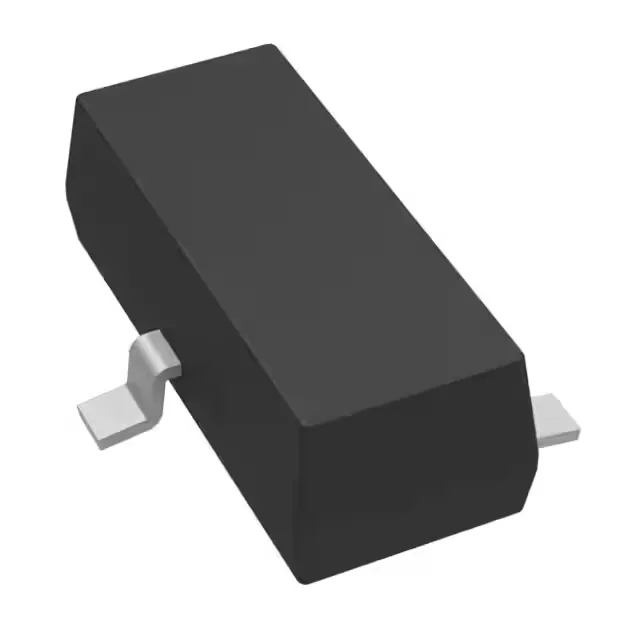
Precision 8.192 V shunt reference for ADC bias and comparator thresholds
The LM4050BEM3-8.2/NOPB is a precision shunt voltage reference from Texas Instruments that delivers a fixed 8.192 V output with ±0.2% initial tolerance — tight enough to set the full-scale voltage for a 12-bit ADC without external trimming, or to establish a stable comparator threshold in an industrial sensor circuit. As a shunt reference, it behaves like a precision Zener diode: you connect it between the supply rail and ground through a single series resistor. The cathode current must stay between 100 µA and 15 mA for the output to regulate, so the resistor value is calculated from the supply voltage minus 8.192 V divided by the sum of the load current and the reference's own quiescent current.
Package and board-fit — SOT-23-3 footprint
The SOT-23-3 package (also known as TO-236-3 or SC-59) is a three-pin surface-mount package with a 0.95 mm pitch — the same footprint as a small-signal transistor. It fits tight layouts on two-layer boards and shares a common land pattern with many other shunt references, so a single PCB pad can accept multiple BOM alternatives. Supplied in Tape & Reel (TR) for automated pick-and-place, or Cut Tape (CT) for prototype builds and small-batch rework. The reel quantity is the standard 3000-piece reel for SOT-23-3; cut tape is slit to order.
Noise performance and output stability
For a 12-bit ADC with a 8.192 V reference, the LSB is 2 mV, so the reference noise contributes less than 0.1 LSB of jitter to the conversion result. In a 16-bit system the noise budget is tighter and may require external filtering. The fixed 8.192 V output is a convenient midpoint for bipolar ADC inputs that swing ±10 V, or as a precision bias for comparator thresholds in over-voltage and under-voltage detection circuits. The ±0.2% tolerance is guaranteed over the full temperature range, not just at 25 °C.
ROHS3 compliant, with no restricted substances above the threshold limits and no exemption expiry to track. The part is also REACH and halogen-free per TI's standard compliance documentation, though those certifications are not explicitly listed in the spec table.