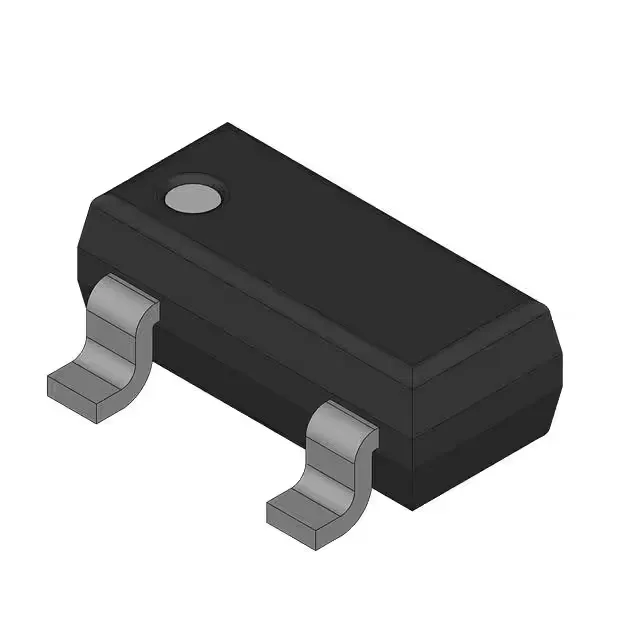
10V shunt reference with ±0.1% initial accuracy
The LM4050AIM3-10: This places it in the tight-tolerance tier for a shunt reference — suitable for biasing the reference input of a 12-bit or 14-bit ADC where the reference error directly scales the conversion uncertainty. Temperature drift is rated at 50 ppm/°C, so from 25°C to 85°C the output shifts by roughly 30 mV worst-case — within the LSB budget of a 12-bit system spanning 10V. The 150 µVrms noise floor from 10 Hz to 10 kHz keeps the reference clean for most precision analog chains.
Package, supply, and temp grade
Housed in a three-pin SOT-23-3 surface-mount package (also listed as TO-236-3 / SC-59), the LM4050AIM3-10 occupies minimal board area. The cathode current is 103 µA typical, and the device can sink up to 15 mA — enough to drive the reference input of multiple converters or a small resistive divider network. As a shunt reference, it requires an external series resistor to set the bias current — the resistor value is calculated from the supply voltage minus 10V divided by the desired cathode current.
Active lifecycle and compliance note
Supplied in bulk packaging rather than tape-and-reel, so it is suited for prototype builds, repair stock, or low-volume production where reel feed is unnecessary.