Last Buy – plan your final orders
The LM4041DILP is on a Last Buy lifecycle stage. That means the manufacturer has announced end-of-life and is accepting final orders for a limited window. Once that window closes, the part will no longer be produced. For a BOM that depends on this exact reference, the decision is straightforward: secure your lifetime buy quantity now, or qualify a replacement before stock dries up.
Adjustable shunt reference – what the ratings mean
This is an adjustable shunt voltage reference from the LM4041 family. The output voltage is set with two external resistors, ranging from a minimum of 1.233 V up to a maximum of 10 V. The ±1% tolerance is the initial accuracy at 25 °C – tight enough for 8- to 10-bit ADC references and general-purpose biasing, but not for high-precision 12-bit-plus designs where a 0.1% or better reference would be specified. The shunt architecture means it operates like a Zener diode: it sinks current from the supply through a series resistor. The 12 mA maximum output current sets the load it can drive, and the 80 µA minimum cathode current is the quiescent draw needed to keep the reference in regulation. Below 80 µA the output voltage may drift out of spec, so the series resistor must be sized to guarantee at least that much current at the minimum supply voltage.
Temperature range and noise floor
The temperature coefficient is 150 ppm/°C, which means a 1°C change shifts the output by 0.015% of the set voltage. Over a 50°C swing that adds up to 0.75% drift on top of the initial tolerance. For a 2.5 V output, that is about 19 mV of total variation worst-case. The 20 µVrms noise (10 Hz to 10 kHz) is low enough that it will not limit a 10-bit ADC, but a 16-bit system would want a lower-noise reference.
Through-hole package – board fit
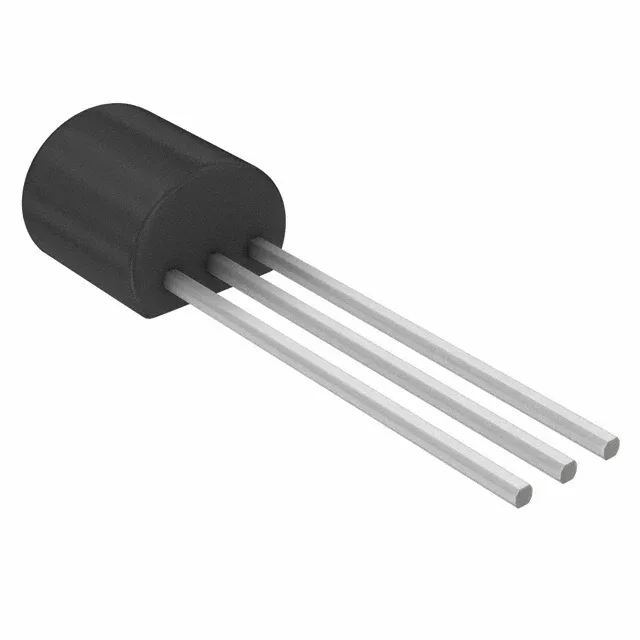
The TO-92-3 (TO-226AA) package is the classic three-lead transistor outline, through-hole mount. It is a hand-solder-friendly form factor for prototyping, rework, or low-volume production. The pinout is standard for a shunt reference: cathode, anode, and no-connect (or the adjust pin on the adjustable version). No special footprint or thermal pad is needed – just three 0.100-inch pitch holes.