What this shunt reference does — and the one spec that catches people out
Unlike a series reference, it sinks current through a cathode to regulate its output voltage, set by two external resistors. The output adjusts from a minimum of 1.233 V up to 10 V, making it a flexible bias source for ADC references, comparator thresholds, or current-loop supplies. The catch with any shunt reference: you must bias it with a resistor from the supply to the cathode, and that resistor must pass at least 80 µA (the minimum cathode current) plus the load current to keep regulation. At 12 mA maximum output, the resistor drop and power dissipation need a quick calculation — the SOT-23-3 package handles it, but don't assume zero-load operation.
Tolerance and drift — where the ±1% matters
Initial tolerance is ±1% at 25°C. For a 2.5 V output, that's ±25 mV — fine for an 8-bit ADC reference or a comparator threshold where a few millivolts of offset are acceptable. If your design needs 0.1% or better, step up to the LM4041A or LM4041B grades. Temperature coefficient is 150 ppm/°C typical. Not a precision metrology part, but stable enough for industrial control loops and data-acquisition front ends.
Noise floor for sensitive analog rails
That's low enough to feed the reference input of a 12-bit SAR ADC without the noise degrading the LSB — the noise contribution is well below 1 LSB at 2.5 V full scale.
Package and rework — SOT-23-3 is a friend under the hot air
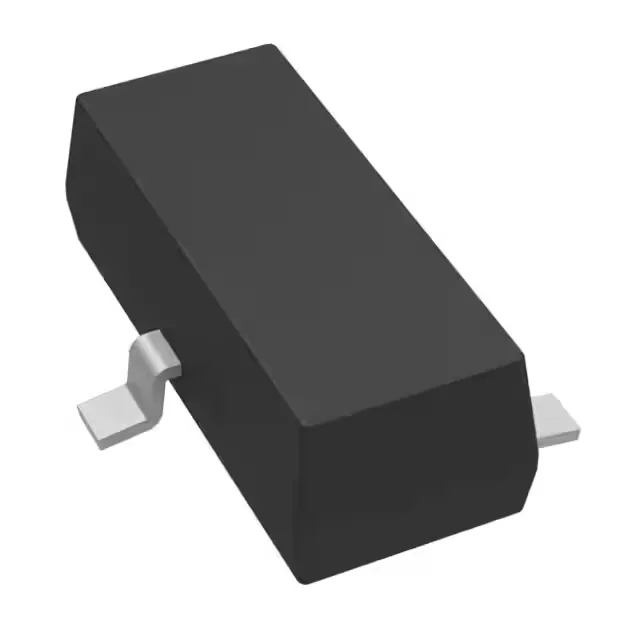
The SOT-23-3 package (also known as TO-236-3 or SC-59) is a three-pin device with a small footprint — about 2.9 mm x 1.3 mm. The small thermal mass means it reflows easily with a hot-air station at 300°C for 10-15 seconds. No exposed pad, no underfill needed. Just watch the orientation: the package has a chamfer on pin 1 side.
For volume production, the base part number LM4041 spans multiple tolerance grades (A/B/C/D) and package options, so dual-sourcing across the family is straightforward — just match the tolerance and package code.