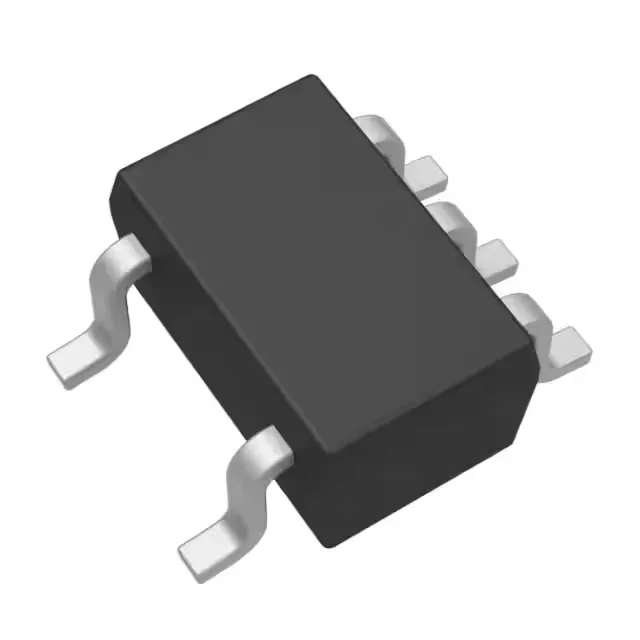
It operates as a shunt regulator, meaning it sinks current from a supply through a series resistor to maintain the reference voltage at the output node. The ±0.5% tolerance sets the initial accuracy floor for the system — a 1.225 V reference with ±0.5% gives a worst-case spread of about 6 mV, which is tight enough for 8- to 10-bit ADC references or comparator thresholds in industrial control loops.
Output current and cathode current — the bias budget
The device can source up to 12 mA of output current while the minimum cathode current required for regulation is 80 µA. In a typical bias circuit, the series resistor must be sized so that the current through the reference stays between 80 µA and 12 mA over the full load and supply range. The 100 ppm/°C temperature coefficient means the output voltage drifts by 100 ppm per degree Celsius — at 1.225 V that is about 122.5 µV/°C, which matters if the reference sees wide thermal swings in an outdoor or engine-bay environment.
Package and temperature grade — fit for production
Housed in an SC-70-5 package, the part is a surface-mount device suited for automated assembly. The Tape & Reel (TR) packaging is the standard delivery format for pick-and-place lines.