8.192 V shunt reference — the decision anchor
The shunt topology means it behaves like a two-terminal Zener: you bias it through a series resistor from a higher-voltage rail, and the reference regulates by shunting current to ground.
Tolerance and drift — the accuracy budget
Initial output accuracy is ±1% — at 8.192 V that is ±82 mV before temperature effects. The 150 ppm/°C temperature coefficient adds another ±0.015% per °C away from 25°C.
Output current and cathode current — biasing the shunt
The reference can sink up to 15 mA of output current while maintaining regulation. Minimum cathode current is 115 µA — the series resistor must be sized so that the total current (load current plus the 115 µA minimum) keeps the device in its operating region. If the load draws less than 115 µA, the excess current flows through the shunt; if the load draws more than 15 mA, the reference drops out of regulation. This is the standard trade-off with shunt references: the series resistor value sets the quiescent power dissipation.
Noise floor for sensitive analog rails
Wideband noise is specified at 130 µVrms over the 10 Hz to 10 kHz band. For a 12-bit ADC with an 8.192 V reference, one LSB at 12 bits is 2 mV — the 130 µVrms noise contributes about 6% of one LSB, which is acceptable for most industrial and instrumentation applications. For audio or metrology-grade paths, a lower-noise reference (e.g., the LM4040A series with tighter tolerance) would be the better fit.
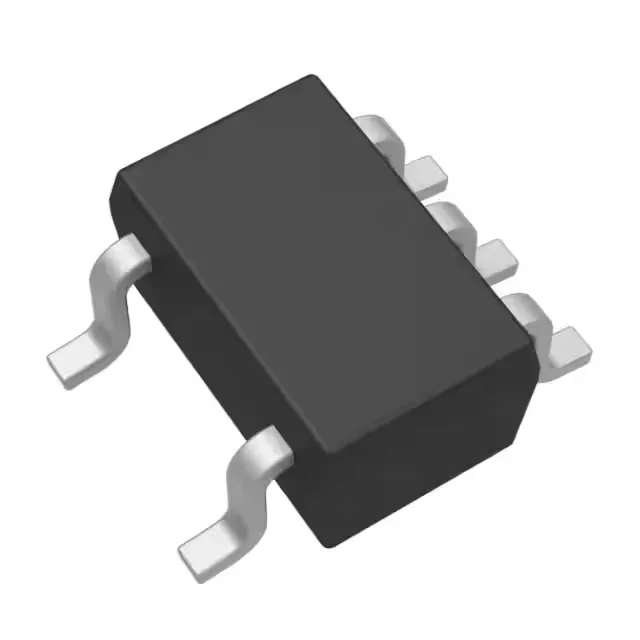
Package and footprint — SC-70-5 constraints
The SC-70-5 (SOT-353) package is a 5-lead surface-mount package with a 0.65 mm pitch and a body size of roughly 2.1 mm × 2.0 mm.
The base product number is LM4040, covering multiple voltage options and tolerance grades across the SC-70-5 package family.