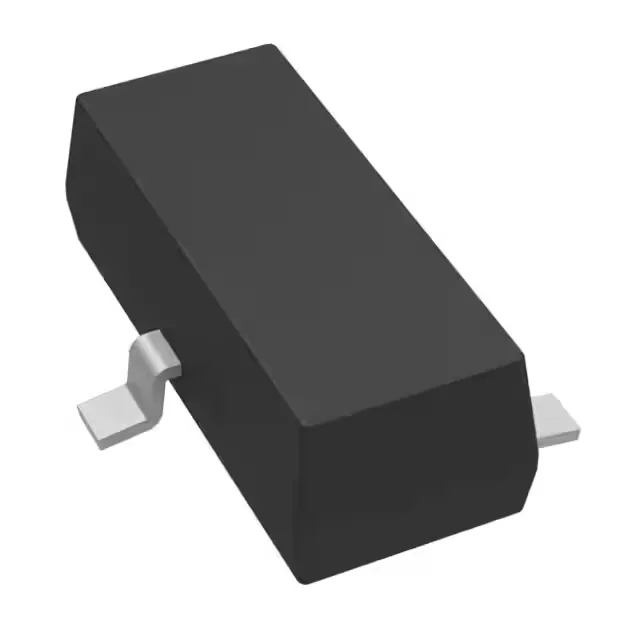
It is part of the LM4040 family, a widely used series of low-power shunt references available in multiple voltage options and tolerance grades. The shunt topology means it behaves like a two-terminal Zener diode — it regulates by shunting current through the cathode to ground, making it suitable for series or shunt configurations in precision bias supplies, ADC/DAC reference inputs, and comparator threshold circuits.
Output current and cathode current — the operating envelope
The LM4040D82IDBZT is rated for a maximum output current of 15 mA and a minimum cathode current of 115 µA. The shunt regulator must be biased with a series resistor that supplies at least 115 µA through the cathode to maintain regulation; below that threshold the output voltage may drift. The 15 mA ceiling limits the load the reference can drive directly — for higher current demands, a buffer amplifier is needed.
Noise performance and application fit
Wideband noise from 10 Hz to 10 kHz is specified at 130 µVrms. For a 8.192 V reference, that is roughly 16 ppm rms — adequate for general-purpose precision analog circuits but not low-noise enough for high-resolution sigma-delta converters without additional filtering. The shunt architecture inherently has lower noise than bandgap references at similar quiescent current, which is a practical advantage in battery-powered instrumentation where every microamp counts.
The SOT-23-3 footprint is shared across the entire LM4040 voltage range, so a different voltage variant can be substituted without a PCB change.