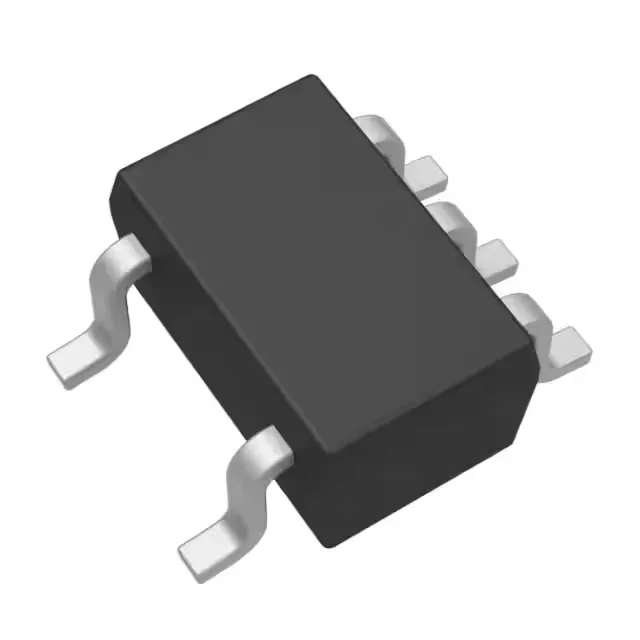
Fixed 5V shunt reference in a small footprint
It is designed for applications requiring a stable voltage reference in a compact surface-mount package. As a shunt reference, it behaves like a Zener diode: it requires a series resistor from the supply to the cathode, and it regulates the voltage across itself by shunting current to ground. The 95 µA minimum cathode current keeps it biased even at light loads.
The ±1% initial accuracy means the output voltage is guaranteed within 5V ±50 mV at 25°C. For a 12-bit ADC with a 5V reference, this contributes about ±10 LSB of full-scale error before any calibration. In a system that operates across temperature extremes, this drift may dominate the error budget — plan for a trim or a tighter-grade reference if sub-10 mV stability is required.
Output current and noise — driving the load
The LM4040D50IDCKR can source up to 15 mA of output current. The shunt architecture means the total current drawn from the supply is the load current plus the cathode current (95 µA minimum). For a 1 mA load, the series resistor must be sized to deliver 1.095 mA at the minimum supply voltage. This is low enough for most 10- to 12-bit precision converters, but for 16-bit or higher resolution, a lower-noise reference or additional filtering may be needed.
The SC-70-5 package (also known as SOT-353) is a 5-lead, 2.0 mm × 2.1 mm body, 0.65 mm pitch.