Fixed 4.096V shunt reference for precision bias and ADC rails
This voltage is a standard full-scale reference for 12-bit and 16-bit successive-approximation ADCs, where the 4.096V level simplifies ratiometric measurements — each LSB corresponds to 1 mV for a 12-bit converter, making system calibration straightforward. The shunt topology means the device operates as a two-terminal Zener-like reference: it sinks current from a series resistor connected to a higher supply rail. The cathode current range spans from 88 µA quiescent up to 15 mA maximum output, which sets the resistor value and the power dissipation budget in the BOM.
Noise and drift — the error-budget specs
Wideband noise is specified at 80 µVrms over the 10 Hz to 10 kHz band. For a 4.096 V reference feeding a 16-bit ADC with a 1 LSB weight of 62.5 µV, this noise contribution sits below one LSB — acceptable for most industrial data-acquisition channels without additional filtering. That is about 0.015% of the 4.096 V output; for a 12-bit system the drift is negligible, but a 16-bit design should budget this into the system accuracy calculation.
Through-hole TO-92-3 — layout and sourcing notes
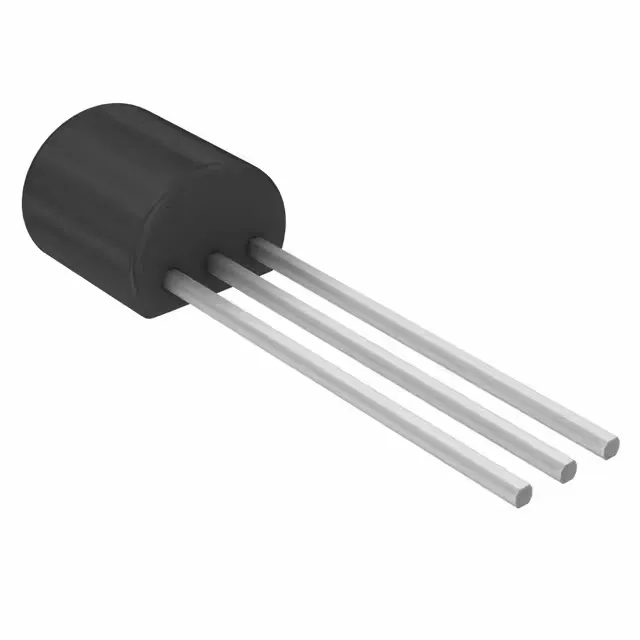
The LM4040D41ILPR comes in a TO-226-3 (TO-92-3) through-hole package with formed leads, identified as supplier device package TO-92-3. This is the standard three-lead transistor outline, pin-compatible with many other shunt references in the same family. Through-hole mounting suits prototyping, low-volume production, and boards that go through wave-solder assembly rather than reflow. The package is offered in Cut Tape (CT) and Tape & Box (TB) formats, which affects pick-and-place handling only for automated through-hole insertion — not a concern for hand-assembly or socketed test fixtures.