It delivers a ±1% initial tolerance and a 150 ppm/°C temperature coefficient, with a 15 mA maximum output current and an 80 µA cathode current floor. The shunt topology means it behaves like a Zener diode — you set the bias current with an external resistor, and the reference regulates the voltage across its terminals.
The ±1% initial accuracy on the 2.5V output means the actual voltage you get from a fresh part can be anywhere from 2.475V to 2.525V. For a 10-bit ADC with a 2.5V reference, that's about ±2.5 LSBs of gain error before you add the ADC's own offset and INL. If your design needs better than 1% absolute accuracy — say, a 12-bit or 16-bit ADC reference — you'll want to budget a trim or move to a tighter-tolerance sibling like the LM4040A (0.1%). For comparator thresholds or bias supplies where a few tens of millivolts don't matter, this grade is fine.
Shunt topology — the resistor sets the dissipation
Because this is a shunt reference, the total current drawn from the supply is the sum of the load current and the cathode current. The cathode current must be at least 80 µA to maintain regulation; the maximum is 15 mA. The external series resistor is sized to deliver that current at the minimum supply voltage. If the supply varies, the resistor drops the excess voltage, and the shunt absorbs the extra current. That means the power dissipated in the reference is I_cathode × 2.5V — at 15 mA it's 37.5 mW, well within the TO-92-3's thermal capability, but at higher ambient temperatures the derating curve matters. Keep the resistor's power rating in mind too: at 24V supply and 15 mA load, the resistor drops 21.5V at 15 mA, which is 322 mW — a 1/2W resistor minimum.
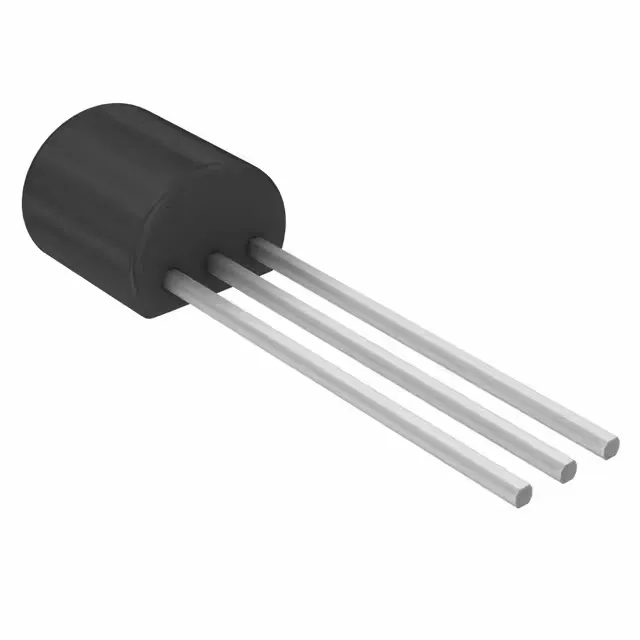
The TO-92-3 package is a standard through-hole format, widely available through independent distribution.