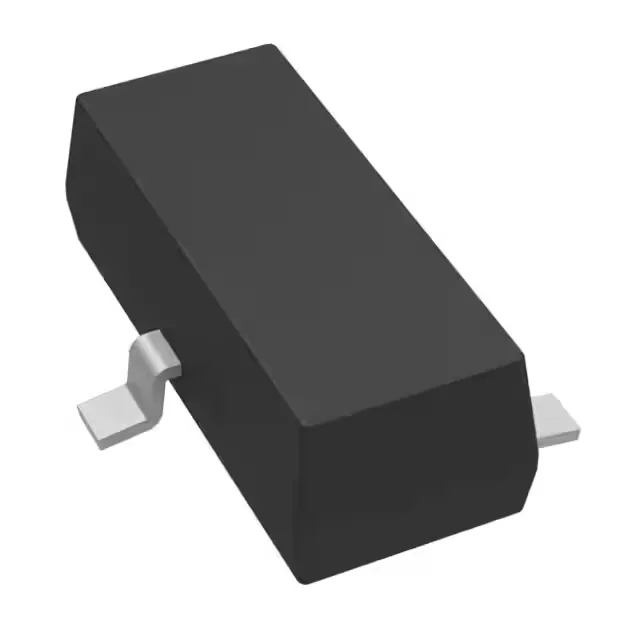
2.5 V shunt reference in an SOT-23-3 — what you need to know
It operates as a two-terminal shunt device — no external pass transistor needed, just a single series resistor from the supply rail to the cathode. The 80 µA minimum cathode current lets you bias it from a high-impedance source, while the 15 mA maximum gives headroom for driving ADC reference inputs or comparator thresholds. Noise is specified at 35 µVrms over the 10 Hz to 10 kHz band, clean enough for 12-bit systems with proper bypassing.
Bias resistor sizing — the common gotcha
Because this is a shunt reference, the series resistor must supply both the load current and the minimum 80 µA cathode current. Pick the resistor value so that (Vcc – 2.5 V) / R ≥ I_load + 80 µA. At the other end, the resistor must not force more than 15 mA into the cathode when the load is at its minimum. A 1 kΩ resistor from a 5 V rail gives about 2.5 mA — safe and leaves margin for a 1 mA load. Go below 470 Ω and you risk exceeding the 15 mA ceiling on a no-load condition.
No end-of-life notices have been published for this base part number. For dual-sourcing flexibility, the shunt-reference topology is widely second-sourced — TI's own LM4040 family spans multiple tolerance grades and voltages, all pin-compatible in the SOT-23-3 footprint. The ±1% D-grade is the cost-optimized entry point; if your design needs tighter drift, the A-grade (0.1%) variant shares the same package and pinout.
The surface-mount package suits automated pick-and-place lines.