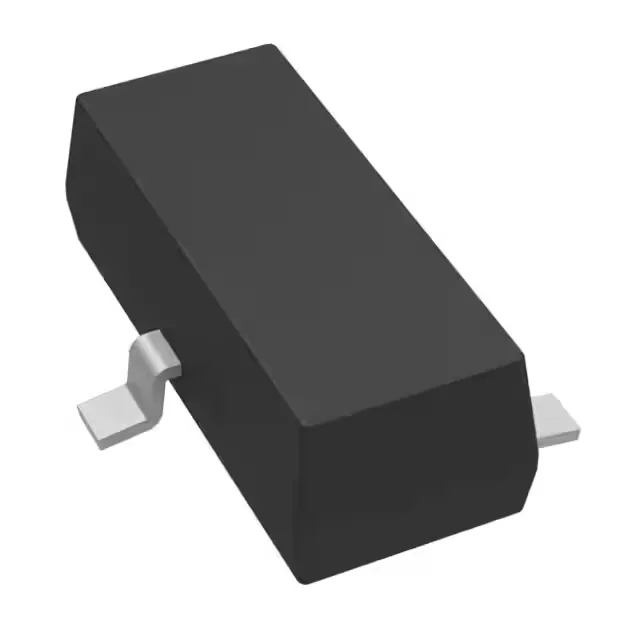
2.5V shunt reference in a standard SOT-23-3 footprint
As a shunt (two-terminal) reference, it behaves like a Zener diode — it regulates the voltage by shunting current through the cathode to ground, requiring only a series resistor from the supply. The 80 µA minimum cathode current lets it operate from very low bias, and the 15 mA output capability can source external loads when the total current through the reference stays within that ceiling. Noise is specified at 35 µVrms over 10 Hz to 10 kHz, clean enough for 12-bit ADC references in moderate-speed industrial and instrumentation designs.
SOT-23-3 package — pick-and-place friendly
The part is supplied in a SOT-23-3 package, a standard three-pin footprint that places reliably on standard reflow profiles. MSL level is not explicitly stated in the record, but SOT-23-3 packages typically carry MSL 1 or 2 — verify the reel label before opening the moisture barrier bag. No exposed pad or thermal vias are needed; the shunt topology dissipates power through the series resistor, not the package.
Shunt vs. series — picking the right topology
The LM4040D25IDBZR is a shunt reference, meaning it regulates by sinking current. This is different from a series reference like the LM4132AMF-4.1/NOPB, which regulates by sourcing current and requires a supply voltage above the output. The shunt topology is simpler — no separate supply pin, just two terminals — and it can be used to generate a negative reference or float above ground. The trade-off: the series resistor must be sized to handle the sum of the load current and the reference's cathode current, and the 80 µA minimum cathode current sets a floor on the resistor value. For designs where the supply is noisy or varies widely, a shunt reference often rejects supply ripple better because the resistor acts as a low-pass filter with the reference's dynamic impedance.