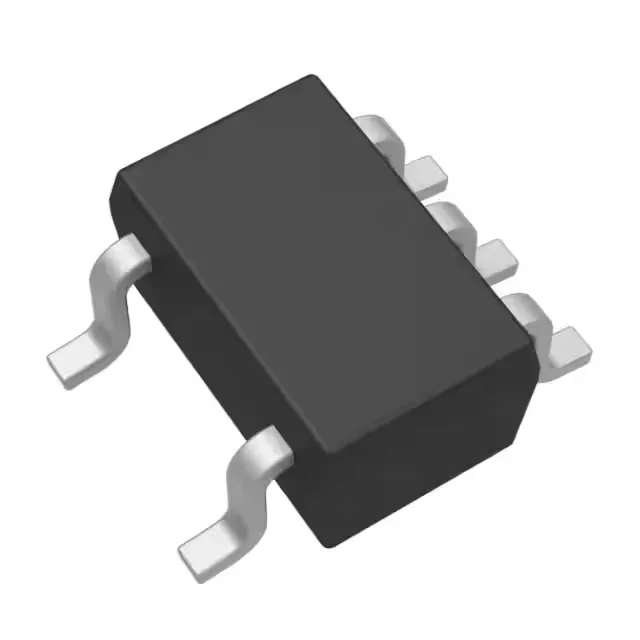
5V shunt reference in a SC-70-5 — what you need to know
The Texas Instruments LM4040CIM7X-5.0/NOPB is a precision shunt voltage reference delivering a fixed 5V output with a ±0.5% initial tolerance. It operates as a shunt (two-terminal) reference, meaning it sinks current through a series resistor from a higher supply rail to regulate the output voltage — a topology that works well in low-power and single-supply designs where a dedicated reference IC with a ground pin would add cost or complexity. The SC-70-5 package (also known as SOT-353) keeps the board footprint small, which suits space-constrained layouts in portable instruments, sensor modules, and industrial control I/O cards. The cathode current requirement of 80 µA minimum means the series resistor must be sized to supply both the reference and the load without starving the device.
For new designs, a pin-compatible alternative from the same LM4040 family (such as the LM4040CIM3-5.0 in SOT-23-3) may be considered, but the SC-70-5 footprint is specific to this variant. Availability is through independent distribution channels — sealed reels with consistent date-codes are sourced from factory excess and end-of-line lots.
Noise, drift, and temperature range — bench-level expectations
Output noise is specified at 80 µVrms over a 10 Hz to 10 kHz bandwidth — a clean reference for 12-bit and some 14-bit ADC applications where the reference noise floor matters. For a 5V reference, that is roughly 0.01% accuracy shift across temperature — adequate for general-purpose instrumentation but not for metrology-grade systems. The output is rated for 15 mA maximum cathode current. In practice, the series resistor should be chosen so that the total current through the reference (load current plus quiescent) stays within this limit while keeping at least 80 µA flowing to maintain regulation.