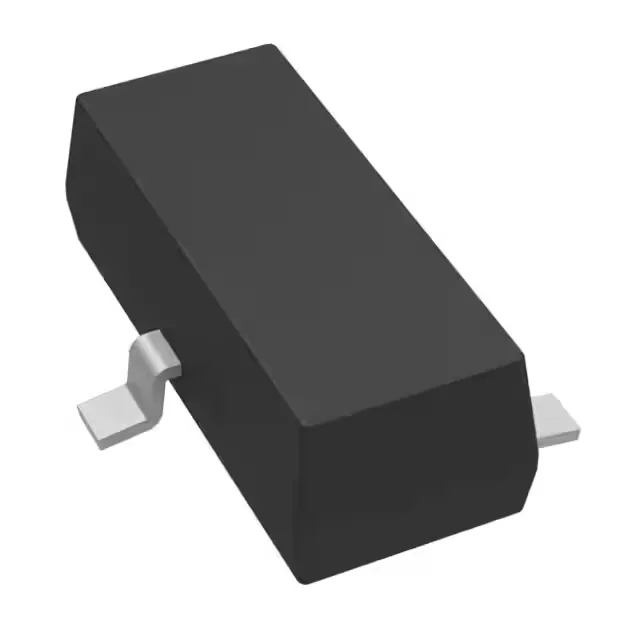
Fixed 5V shunt reference for precision bias and ADC rails
The Texas Instruments LM4040CEM3X-5.0/NOPB is a precision shunt voltage reference delivering a fixed 5V output with ±0.5% initial tolerance. The shunt topology means it behaves like a two-terminal Zener — no separate supply pin, just a cathode and anode — which simplifies the BOM for generating a stable bias rail from an existing higher-voltage supply.
Noise floor and temperature drift — the precision story
For a 12-bit ADC with a 5V reference, that noise contribution sits well below 1 LSB, so you can skip the external RC filter on the reference input. The temperature coefficient is 100 ppm/°C — a 5V reference drifts 0.5 mV per °C, which adds about 0.01% of full-scale error over a 100°C swing. That is tight enough for most industrial control loops and data acquisition front-ends.
Shunt current budget and cathode current floor
The LM4040CEM3X-5.0/NOPB can sink up to 15 mA of output current while maintaining regulation. The minimum cathode current for stable operation is 83 µA — below that the reference may drop out of regulation. In practice, size the series resistor from the supply rail to deliver between 100 µA and 15 mA through the device, accounting for the load current drawn by the downstream circuit. A 1 kΩ resistor from a 12V rail gives about 7 mA bias, leaving headroom for a 5 mA load.
The part comes in a standard SOT-23-3 package (TO-236-3 / SC-59 compatible). The three-pin footprint is the same as a small-signal transistor — anode, cathode, and no-connect (NC). No thermal pad is needed; the shunt reference dissipates power as I_cathode × V_reverse, and the SOT-23-3 copper trace area on a typical 2-layer board handles the thermal load up to 125°C ambient.