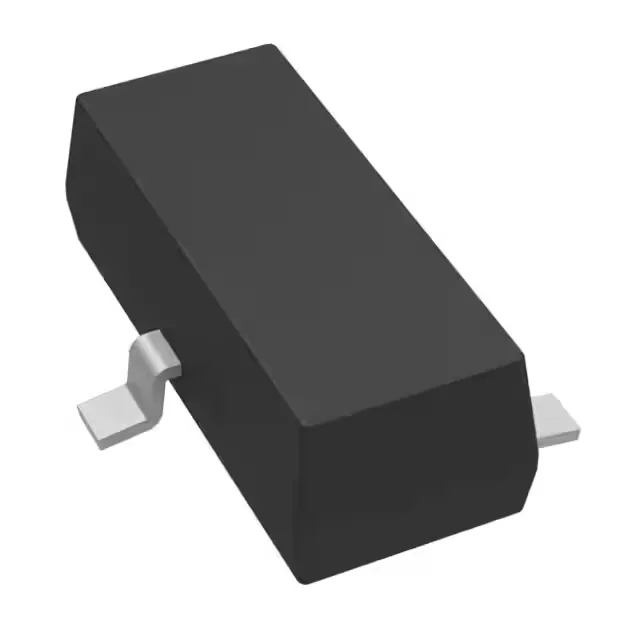
The shunt topology means it behaves like a two-terminal Zener diode — it regulates the voltage by sinking current through the cathode, so no external series pass element is needed. Typical applications include biasing ADCs and DACs, setting comparator thresholds, and providing a stable reference for industrial sensors or battery-monitoring circuits where board space is tight.
The ±0.5% initial tolerance is the accuracy a designer gets at 25°C without any external trimming — adequate for a 10-bit ADC reference where the LSB is about 2.44 mV at 2.5V full scale. The 35 µVrms noise (10 Hz to 10 kHz) is low enough that it won't dominate the ADC's own noise floor in a 12-bit system with a 2.5V reference, but a 16-bit design would typically need a lower-noise reference like the LM4040A series with tighter tolerance and lower noise. The 68 µA cathode current minimum means the reference must be biased with a resistor that delivers at least that current; the 15 mA maximum output current sets the upper limit on the load the reference can drive while staying in regulation.
Sourcing this NRND reference — what to expect
Because the LM4040CEM3-2.5 is NRND, standard distributor stock may dwindle. The SOT-23-3 package is widely used, so if the exact C-grade tolerance is not critical, a ±0.5% or ±1.0% sibling in the same package can often be substituted with a BOM update. No stock-holding claim is made; the supply posture is per-RFQ.