8.192V shunt reference — precision bias for ADC/DAC rails
That specific voltage is no accident — it aligns with the full-scale range of many 12- and 14-bit ADCs that use a 4.096V or 8.192V reference input, giving a 1 LSB = 2 mV or 500 µV step respectively. The ±0.5% initial tolerance means the output sits between 8.151V and 8.233V at 25°C without any external trim. As a shunt reference, it behaves like a precision Zener diode: you set the current through it with a single series resistor from a higher supply rail, and the LM4040 regulates by shunting current to ground. The cathode current floor is 110 µA, so the bias resistor must deliver at least that much at minimum input voltage. Maximum output current is 15 mA — enough to bias a handful of ADC inputs or a small buffer amp, but not for powering downstream circuitry.
130 µVrms noise — where it fits in the precision chain
Output noise is specified at 130 µVrms over the 10 Hz to 10 kHz band. For a 12-bit system with an 8.192V reference, that noise represents about 0.6 LSBs of peak-to-peak jitter (assuming 6.6 × rms for peak-to-peak). That's acceptable for most industrial ADC applications, but a 16-bit design would see 10+ LSBs of noise — you'd want a lower-noise reference or a post-filter.
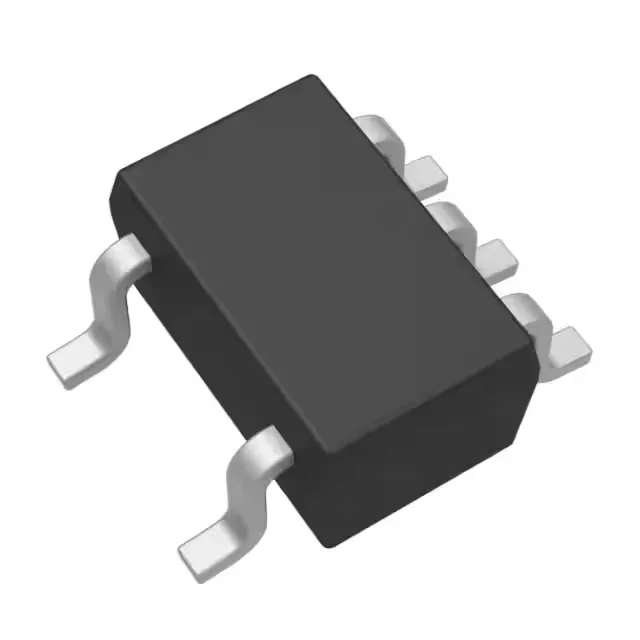
SC-70-5 package — board-area tradeoffs
The SC-70-5 (also known as SOT-353) package is a 5-pin, 2.0 mm × 2.1 mm body with 0.65 mm pin pitch. It's a surface-mount part that saves board space compared to an SOT-23, but the small pad geometry means the solder stencil aperture needs to match — a 0.1 mm thick stencil with 1:1 aperture-to-pad ratio is typical.
The base product number LM4040 covers a whole family of fixed-voltage shunt references from 2.048V to 10V, so if your next design needs a different voltage, the pinout and package options carry across.