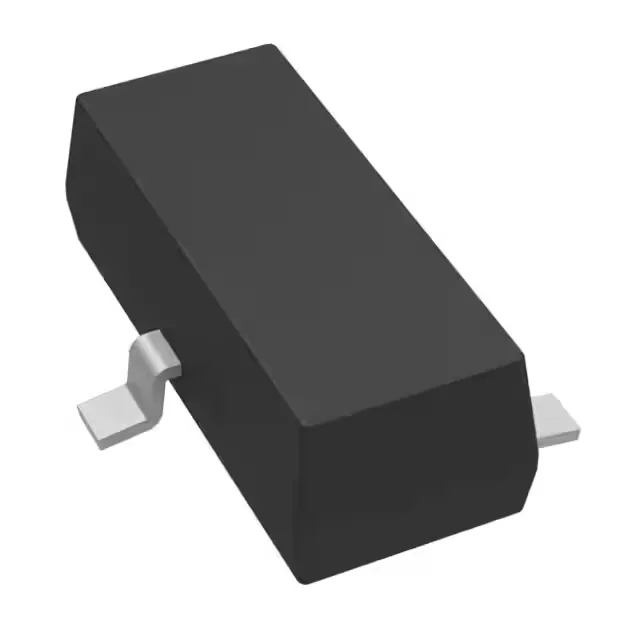
4.096 V shunt reference — the decision spec
The Texas Instruments LM4040C41IDBZT is a precision shunt voltage reference delivering a fixed 4.096 V output with ±0.5% initial tolerance.
Because this is a shunt reference, it needs an external series resistor between the supply rail and the cathode pin. That resistor sets the operating current — it must supply enough current to keep the device above the 88 µA minimum at all load conditions, but not exceed the 15 mA maximum output. The resistor value depends on your supply voltage and the load current drawn by downstream circuits. This topology is simpler than a series reference for high-voltage rails (the shunt just drops the excess voltage as heat), but it's less efficient at low load currents since the minimum cathode current always flows. For battery-powered designs, the 88 µA quiescent current is a fixed overhead you should budget for.
Temperature stability and noise
The temperature coefficient is specified at 100 ppm/°C, which means the output voltage can shift by up to 0.41 mV per degree C. For a 12-bit ADC with a 4.096 V reference, that's roughly 1.2 LSBs of drift — acceptable for many industrial and instrumentation applications.
The device comes in a standard SOT-23-3 package (also listed as TO-236-3 / SC-59). The three pins are cathode, anode, and no-connect — there's no feedback or trim pin.
The base product number is LM4040, a long-running family with broad distribution. The ROHS3 compliance is stated, so no lead-free transition issues for new designs.