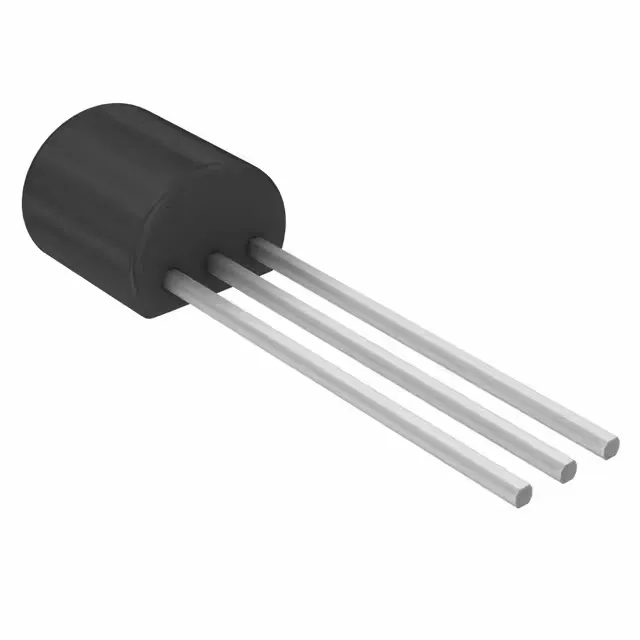
The Texas Instruments LM4040C25ILP is a precision shunt voltage reference that delivers a fixed 2.5V output with ±0.5% initial tolerance. It operates as a shunt (two-terminal) device, meaning it behaves like a Zener diode — you bias it with a cathode resistor from the supply, and the reference sinks the current needed to regulate the output voltage. The 35 µVrms noise (10 Hz to 10 kHz) and 100 ppm/°C temperature coefficient make it suitable for 12-bit ADC references, comparator thresholds, and power-supply monitoring in industrial control, test equipment, and sensor interfaces.
Bias current and power — the shunt trade-off
The LM4040C25ILP requires a minimum cathode current of 80 µA to maintain regulation, and can sink up to 15 mA continuously. That continuous current flow is the trade-off with shunt references: even with no load, the part draws bias current through the cathode resistor, which wastes power in battery-operated designs. For a 5V rail, a 31.25 kΩ series resistor sets the bias at 80 µA; at 15 mA output, the resistor drops to 167 Ω and dissipates 37.5 mW.
Through-hole package — board fit and sourcing
The TO-92-3 (TO-226AA) through-hole package is a standard 3-lead form factor with 0.100-inch pitch. It is breadboard-friendly and easy to hand-solder or socket, but takes more board area than a SOT-23 surface-mount reference.