2.5V shunt reference with ±0.5% initial accuracy
The 100 ppm/°C temperature coefficient means the output voltage shifts by about 250 µV over a 25°C ambient swing — within tolerance for a 10-bit ADC reference but worth verifying against a 12-bit or higher system budget. As a shunt (two-terminal) reference, it behaves like a precision Zener diode: a series resistor from the supply sets the cathode current, and the reference regulates the voltage across itself. The 80 µA minimum cathode current and 15 mA maximum output current define the resistor value and the load range the part can support.
The 35 µVrms noise (10 Hz to 10 kHz) is low enough that a 12-bit ADC at 2.5V full-scale sees roughly 1 LSB of reference noise — acceptable for most industrial data acquisition, but a lower-noise reference (e.g., 10 µVrms) would be preferred for 16-bit or higher systems. The 100 ppm/°C drift is the dominant error source over temperature. From 25°C to 85°C the voltage can shift up to 15 mV (0.6% of 2.5V), which exceeds the ±0.5% initial tolerance. If the system calibrates at room temperature and operates across the full range, the drift budget must be accounted for in the error stack-up.
SC-70-5 footprint and sourcing posture
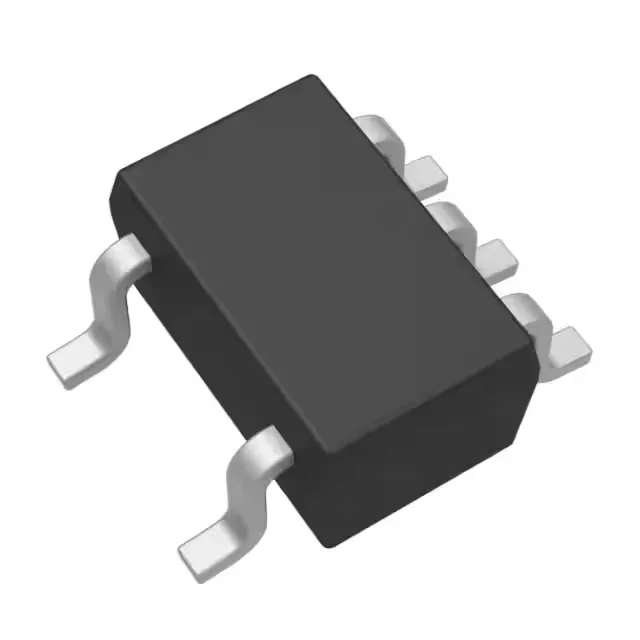
The SC-70-5 (SOT-353) package is a 5-lead surface-mount footprint with 0.65 mm pitch. The small body (2.1 mm × 2.0 mm) saves board area but limits power dissipation — the shunt current plus load current must stay within the package thermal limits. The supplier device package is SC-70-5.