The shunt topology means it behaves like a two-terminal Zener — you bias it through a series resistor from a higher supply rail, and it regulates by sinking current through the cathode. That 80 µA minimum cathode current is the floor you need to stay above for the reference to hold its accuracy; below that, the output starts to drift off the 2.048V mark. The 35 µVrms noise spec (10 Hz to 10 kHz) makes it a clean enough source for a 12-bit ADC reference in a noisy industrial environment, though you'd still want a 100 nF bypass cap right at the reference input pin.
Package and footprint — SOT-23-3 reality check
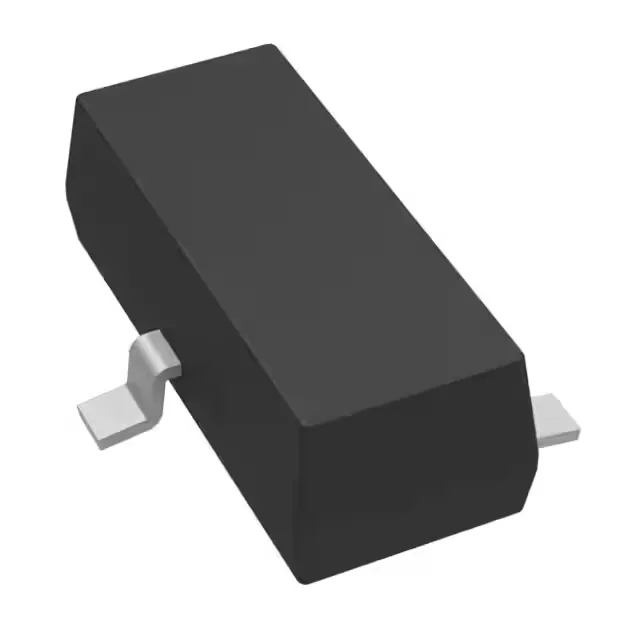
The part comes in a standard SOT-23-3 package (also listed as TO-236-3 / SC-59). Three pins: cathode, anode, and no-connect (NC). The NC pin is internally not bonded, so you can tie it to the cathode or leave it floating — just don't route a critical signal through it. Surface-mount only. The SOT-23-3 footprint is about 2.9 mm × 1.3 mm, which fits comfortably on a 2-layer board with the series resistor and a bypass cap. If you're hand-assembling prototypes, the cut-tape option (CT) is available alongside the standard tape-and-reel (TR) for production reels. No exposed thermal pad to worry about — the shunt dissipates power as (V_in - 2.048V) × I_load, and the SOT-23 handles a few milliwatts without drama as long as the ambient stays under 85°C.
Lifecycle and compliance — active and RoHS3
It's also ROHS3 compliant (lead-free, no exemptions), which clears it for EU and California regulatory requirements. No AEC-Q100 automotive qualification on this variant, so it's aimed at industrial, instrumentation, and general-purpose analog designs rather than under-hood automotive.
What the ±0.5% tolerance means for your BOM
The ±0.5% initial accuracy is one grade tighter than the standard LM4040 variants (which are ±1% or ±2%). For a 2.048V reference, that ±0.5% translates to a worst-case output between 2.0378V and 2.0582V at 25°C. If your ADC's full-scale range is 0–3.3V and you're using the reference to set the top of the conversion range, that 10 mV uncertainty eats into your system accuracy budget. For a 12-bit ADC with a 3.3V reference, the LSB is about 0.8 mV — so the reference's combined error (tolerance + drift) is roughly 13 LSBs. That's fine for a 10-bit system or a comparator threshold, but you'd want a tighter reference (e.g., 0.1% or 50 ppm/°C) for a 12-bit or higher design.