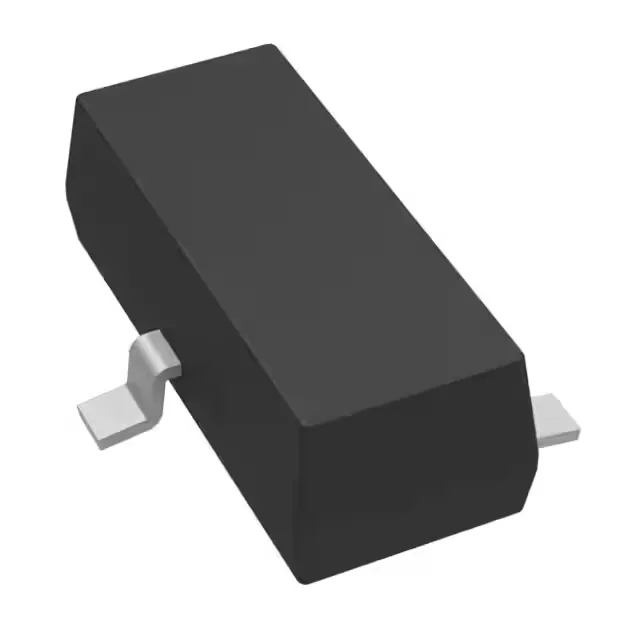
4.096 V fixed shunt — the reference that sets the ADC span
That voltage is not arbitrary — 4.096 V maps cleanly to a 12-bit ADC's 1 mV per LSB or a 16-bit ADC's 62.5 µV per LSB, making it a natural choice for industrial data-acquisition and sensor-conditioning chains where the reference directly sets the measurement span.
The ±0.1% initial tolerance means the output voltage at 25 °C is guaranteed within 4.092 V to 4.100 V — tight enough that many designs skip the external trim pot, saving board area and a calibration step. For a 12-bit system with a 4.096 V reference, that drift is about 1 LSB; for 16-bit, it eats roughly 16 LSBs of the error budget. If your design needs better than 16-bit stability, look at the 50 ppm/°C or 20 ppm/°C variants in the LM4040 family.
Shunt topology — two-terminal simplicity, cathode current matters
As a shunt reference, the LM4040AIM3-4.1/NOPB behaves like a Zener diode: it requires a series resistor from the supply to the cathode pin, and the load current plus the 73 µA minimum cathode current must flow through that resistor to maintain regulation. The 15 mA maximum output current limits the load you can drive directly — for higher loads, buffer the output with an op-amp. The SOT-23-3 package dissipates about 300 mW at 85 °C ambient; a 4.096 V reference sourcing 15 mA into a short would exceed that, so the series resistor must be sized to limit fault current.