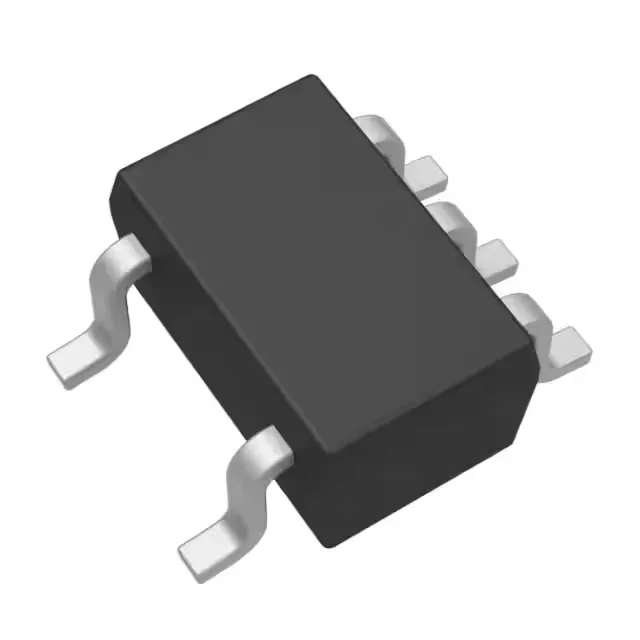
Fixed 5V shunt reference with tight initial tolerance
This is the A-grade variant in the LM4040 family, offering the tightest tolerance bin for applications where the reference voltage directly sets the accuracy of an ADC or DAC conversion. The shunt topology means it behaves like a two-terminal Zener diode — it sinks current from the supply through a series resistor, regulating the voltage across its terminals. That makes it simple to bias from any rail above 5V, with the cathode current set by the resistor value.
Temperature drift and noise floor
For a 12-bit ADC with a 5V reference, that's about 4 LSBs of drift — acceptable for most industrial sensing but worth derating if the system targets 14-bit or better accuracy across temperature. That is low enough for a 12-bit system but may need a post-filter if the reference feeds a high-resolution sigma-delta converter.
Package, footprint, and bias conditions
Housed in a 5-pin SC-70-5 (SOT-353) package, this part occupies minimal board area — roughly 2.0 mm × 2.1 mm. Minimum cathode current is 95 µA, and maximum output current is 15 mA.
The LM4040 family spans multiple voltage options and tolerance grades; if a tighter drift or lower noise is needed, the AEC-qualified or higher-grade variants in the same family are worth evaluating.