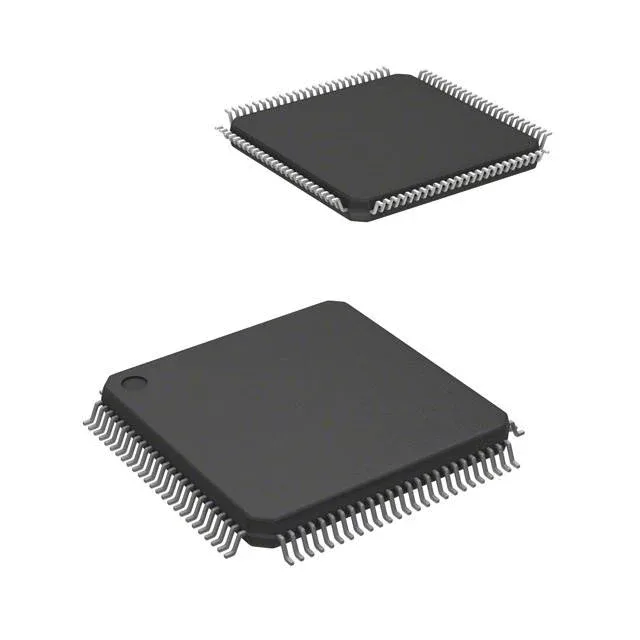
It is built for industrial control, sensor fusion, and human-machine interface applications where the Cortex-M3 architecture provides a good balance of processing throughput and deterministic interrupt response. The 50 MHz clock is enough for most real-time control loops and protocol stacks (TCP/IP offload, CAN, Modbus) without needing a higher-speed part that would add cost and power. The 256 KB program memory and 64 KB data memory give the firmware team room for a RTOS, a communication stack, and moderate application code — if your BOM needs more than that, you are looking at a different density tier.
Peripheral set and I/O — what connects without glue logic
This means most common serial sensors, displays, and radios can connect directly — no external UART-to-SPI bridge or I²C expander needed. The 8-channel 10-bit ADC covers basic analog sensing (potentiometers, thermistors, current shunts) without an external ADC. If your design needs USB, CAN, or Ethernet, this part does not carry them on-chip — you would add an external transceiver or move to a Stellaris variant with those blocks.
This means Texas Instruments will continue to manufacture and ship the part for existing production, but it is not intended for new design wins. For a BOM line already in production, NRND is a signal to evaluate the end-of-life timeline and plan a last-time buy or a migration to a successor. For new designs, the recommendation is to select an active part from the current Stellaris portfolio or an equivalent from NXP, ST, or Renesas.