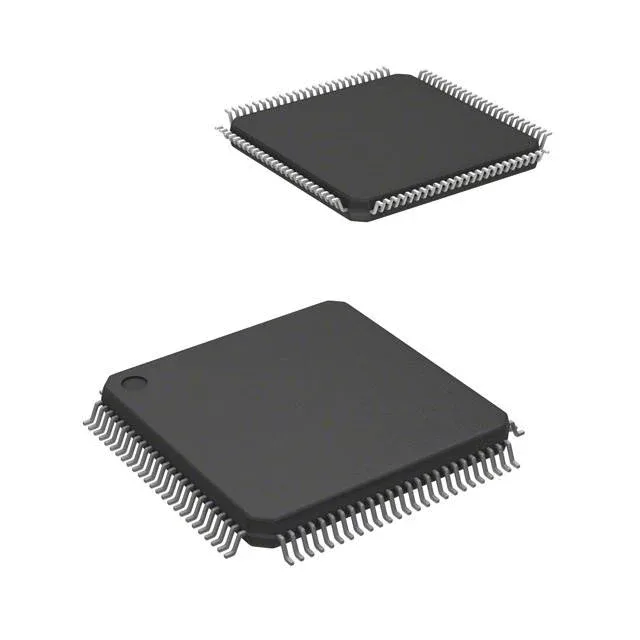
80 MHz Cortex-M3 with integrated Ethernet and USB OTG
The LM3S9U92-IQC80-A2T: The 32-bit core and the peripheral set target connected control applications that need both a real-time processor and a network interface on a single die. The connectivity block is the headline differentiator: CANbus, Ethernet MAC+PHY, USB OTG, plus multiple UART, SPI, I²C, and SSI serial interfaces. For a system that needs to talk to a plant-floor network over Ethernet and to a local HMI over USB, this part eliminates an external network coprocessor.
Memory and peripheral headroom for a connected design
384 KB of flash and 96 KB of SRAM give the application stack room for a TCP/IP stack, a USB device stack, and the main control loop. The 16-channel 12-bit ADC samples analog sensors without an external converter; the PWM and QEI peripherals handle motor feedback directly. The 100-LQFP package (14x14 mm body) with 65 I/O lines provides enough GPIO for a parallel LCD interface or an external memory bus (EBI/EMI is listed in the connectivity set). The internal oscillator saves a crystal on the BOM for applications that can tolerate the internal accuracy; for precision timing, an external crystal feeds the main oscillator input.
Texas Instruments lists the LM3S9U92-IQC80-A2T as obsolete. The Stellaris family was migrated to the Tiva C series several years ago; no direct pin-compatible replacement from TI carries the same peripheral mix. For a BOM line that cannot be redesigned, the existing firmware and PCB layout are tied to this exact order code. A volume quote should confirm lot traceability and date code range before committing the production run.