The 80 MHz Cortex-M3 core delivers enough processing headroom to run a lightweight TCP/IP stack alongside a CANopen or Modbus bridge without a separate protocol coprocessor. The 48 KB SRAM is the buffer budget for Ethernet frames and USB packets; firmware that needs large ring buffers or multiple socket connections will hit that ceiling before the CPU saturates.
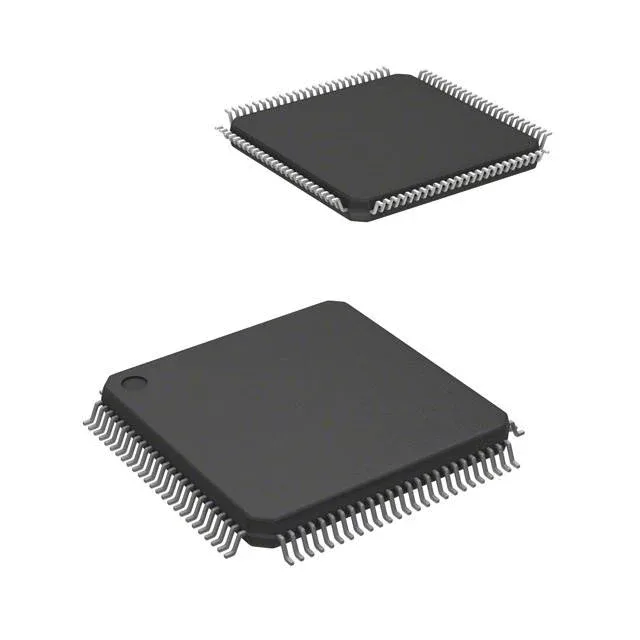
Texas Instruments LM3S9L97-IQC80-C1T ARM Cortex-M3 MCU, 80 MHz
MPNLM3S9L97-IQC80-C1T
Obsolete
Texas Instruments Stellaris ARM Cortex-M3S 9000 series LM3S9L97-IQC80-C1T, 32-bit single-core MCU at 80 MHz, 128 KB Flash, 48 KB RAM, Ethernet MAC+PHY, USB OTG, CAN, 60 I/O, 100-LQFP (14×14 mm), -40°C to 85°C.
Independent supplier — new & surplus stockAuthenticity-screened · ESD-safe packingListing updated Jul 2026
Specifications
| Parameter | Value |
|---|---|
| Series | Stellaris® ARM® Cortex®-M3S 9000 |
| Mounting | Surface Mount |
| Oscillator type | Internal |
| Program memory type | FLASH |
| Voltage - supply (Vcc (Vdd)) | 1.235V ~ 1.365V |
| Operating temperature | -40°C~85°C(TA) |
| Speed | 80MHz |
| Package | Tape & Reel (TR) |
| RAM size | 48K x 8 |
| Core size | 32-Bit Single-Core |
| Peripherals | Brown-out Detect/Reset, DMA, I²S, POR, PWM, WDT |
| Connectivity | CANbus, Ethernet, I²C, IrDA, LINbus, Microwire, QEI, SPI, SSI, UART/USART, USB OTG |
| Number of i (O) | 60 |
| Core processor | ARM® Cortex®-M3 |
| Case | 100-LQFP |
| Data converters | A/D 16x10b |
| Program memory size | 128KB (128K x 8) |
Product details
Frequently asked questions
Is LM3S9L97-IQC80-C1T obsolete?
Yes, Texas Instruments has officially marked the LM3S9L97-IQC80-C1T as obsolete. There is no pin-compatible direct replacement from TI; the Stellaris architecture was superseded by the Tiva C series, which requires a board redesign. Any available units are surplus or broker inventory.
What is the replacement for LM3S9L97-IQC80-C1T?
No official direct replacement is listed by Texas Instruments. The Stellaris family is discontinued; the closest functional successor is the Tiva TM4C129x series, which offers similar Ethernet+USB+CAN integration but in a different package and with a Cortex-M4F core. A board respin is required.
Where can I buy LM3S9L97-IQC80-C1T?
This obsolete part is available through independent distribution channels. Sourced and quoted to order against an RFQ; availability and current pricing are confirmed at quote time. No authorized-distributor stock remains from the manufacturer.
What are the specifications of LM3S9L97-IQC80-C1T?
The LM3S9L97 is a 32-bit ARM Cortex-M3 MCU running at 80 MHz with 128 KB Flash and 48 KB SRAM. It includes Ethernet MAC+PHY, USB OTG, dual CAN 2.0B, and multiple serial interfaces. Operating temperature range is -40°C to 85°C, in a 100-pin LQFP package with 60 I/O and a 16-channel 10-bit ADC.
Is LM3S9L97-IQC80-C1T available available via RFQ confirmation?
No factory-authorized stock remains. This obsolete part is sourced through independent surplus and broker channels. Availability is confirmed at the time of RFQ; no ongoing production or last-time-buy window is open.
LM3S9L97-IQC80-C1T vs LM3S9L96: what are the differences?
Both are Stellaris 9000-series parts with the same 80 MHz Cortex-M3 core, 128 KB Flash, and 100-LQFP package. The LM3S9L97 adds a full Ethernet MAC+PHY and USB OTG controller; the LM3S9L96 omits Ethernet and USB, offering only CAN and serial interfaces. If your design needs wired networking, the LM3S9L97 is the part; if not, the LM3S9L96 is a lower-cost alternative with identical pinout.