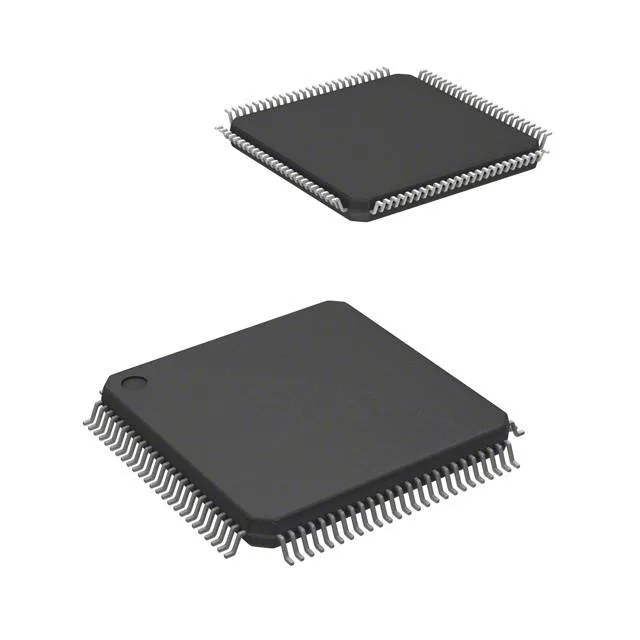
The LM3S9L71-IQC80-C5: The peripheral set includes Ethernet MAC+PHY, USB OTG, two CAN 2.0B controllers, and a full complement of serial interfaces (UART, I2C, SPI, SSI, Microwire, IrDA, LIN, and I2S), making it a single-chip gateway between fieldbus and Ethernet. On-chip analog is handled by a 16-channel, 10-bit ADC.
The Cortex-M3 at 80 MHz delivers roughly 1.25 DMIPS/MHz, or about 100 DMIPS aggregate. That is enough headroom to run a Modbus TCP stack, a PID loop at 10 kHz, and a USB mass-storage class driver simultaneously, with margin left for the application layer. The 48 KB of SRAM is split across a single bank; if you are doing double-buffered Ethernet frames (typically 1.5 KB each) plus a CAN message queue, budget about 12 KB for the networking buffers, leaving 36 KB for stack and data.
Ethernet and USB OTG — the system-integration angle
The integrated Ethernet MAC with dedicated DMA and internal PHY saves an external PHY chip and its associated magnetics routing. The USB OTG controller supports host, device, and OTG negotiation — useful for field-update via USB stick or connecting a Wi-Fi dongle. Both CAN 2.0B ports are Bosch C_CAN cores with 32 mailboxes each, so you can bridge two CAN buses without an external gateway. The 72 GPIOs are 5 V tolerant on most pins, which simplifies level translation when interfacing to legacy 5 V logic or sensors.
Supply rails and power sequencing
The core logic runs from a 1.235 V to 1.365 V supply — a dedicated 1.3 V rail derived from a small LDO or switcher. The I/O ring and analog blocks run from a separate 3.3 V supply. Power-up sequencing requires the core rail to reach 0.9 V before the I/O rail exceeds 2.0 V; the on-chip POR and brown-out detector handle the sequencing if the supplies ramp monotonically. The internal oscillator is factory-trimmed to 1% accuracy, sufficient for UART and CAN without an external crystal, though Ethernet requires an external 25 MHz crystal for the PHY.
Lifecycle and supply outlook
The Stellaris family has a mature, stable supply chain through TI and its authorized distributors. No direct pin-compatible second source exists from another vendor, but the Stellaris 9000 series offers multiple Flash/RAM density options in the same 100-LQFP footprint if a future BOM adjustment is needed.