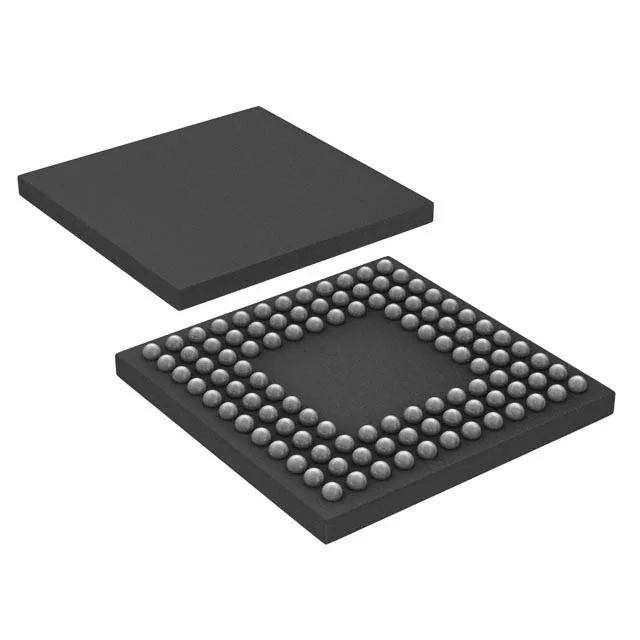
The 108-ball BGA package (10x10 mm) brings out 65 GPIOs, and the on-chip 10-bit ADC has 16 channels.
If you are evaluating a new design, the official TI successor within the Stellaris family is the LM3S9B96 — verify pin compatibility and software migration before committing.
At 80 MHz the Cortex-M3 delivers roughly 1.25 DMIPS/MHz, so about 100 DMIPS available for control loops, protocol stacks, and application code. The 96 KB SRAM is enough for moderate-sized Ethernet or USB buffers without external memory. The 256 KB Flash can hold a full TCP/IP stack plus application firmware; if your code footprint is larger, you will need to step up to the 512 KB variants in the same family.
It is a surface-mount only device; no socketed prototyping. The core supply is 1.235 V to 1.365 V; the I/O bank runs from the main 3.3 V rail. Decouple both supplies close to the balls with low-ESR ceramic capacitors.