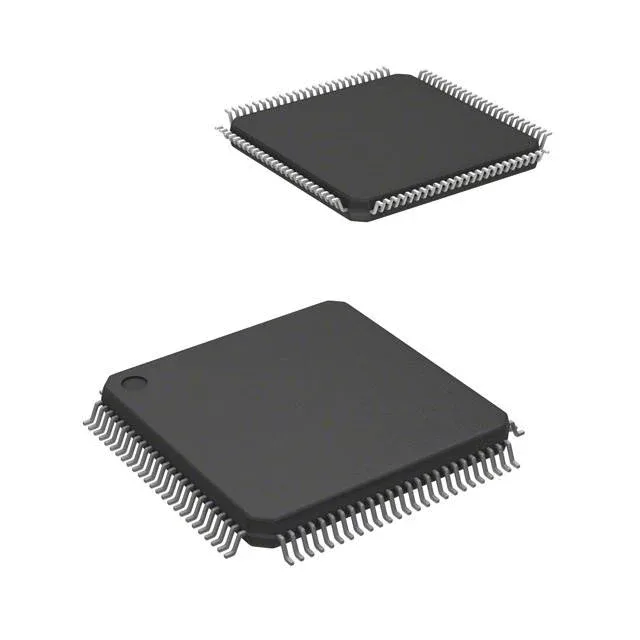
TI LM3S9B81-IQC80-C5T — 80MHz Stellaris Cortex-M3 MCU, 256KB Flash, Dual CAN, Et
Texas Instruments LM3S9B81-IQC80-C5T, Stellaris ARM Cortex-M3S 9000 series, 80MHz 32-bit single-core, 256KB Flash / 96KB SRAM, 65 I/O, 100-LQFP (14×14mm) Tape & Reel, -40°C to 85°C operating temperature, 1.235V–1.365V supply.
Specifications
| Parameter | Value |
|---|---|
| Series | Stellaris® ARM® Cortex®-M3S 9000 |
| Mounting | Surface Mount |
| Oscillator type | Internal |
| Program memory type | FLASH |
| Voltage - supply (Vcc (Vdd)) | 1.235V ~ 1.365V |
| Operating temperature | -40°C~85°C(TA) |
| Speed | 80MHz |
| Package | Tape & Reel (TR) |
| RAM size | 96K x 8 |
| Core size | 32-Bit Single-Core |
| Peripherals | Brown-out Detect/Reset, DMA, I²S, POR, PWM, WDT |
| Connectivity | CANbus, EBI/EMI, Ethernet, I²C, IrDA, LINbus, Microwire, SPI, SSI, UART/USART, USB OTG |
| Number of i (O) | 65 |
| Core processor | ARM® Cortex®-M3 |
| Case | 100-LQFP |
| Data converters | A/D 16x10b |
| Program memory size | 256KB (256K x 8) |
Frequently asked questions
What replaces the LM3S9B81-IQC80-C5T?
There is no pin-compatible drop-in replacement within the Stellaris family. The official migration path is to TI's Tiva C Series TM4C family — firmware rework is required, and TI published a Stellaris-to-Tiva migration guide covering register-level and driver-library differences. The base product number LM3S9B81 is the Stellaris identifier, distinct from any TM4C order code.
Can the dual CAN modules run at different bit rates simultaneously?
Yes. Each CAN module has its own independent bit timing register, so CAN1 and CAN2 can operate at different baud rates on the same die without port sharing. Note that the LM3S9B81 does not support CAN-FD — if CAN-FD is required, a Tiva TM4C part is needed instead.
Does the integrated Ethernet PHY need external magnetics, and what isolation rating is needed for an industrial Profinet IO module?
External magnetics are required — the PHY is integrated but the 10/100 interface needs a standard magnetics module. For a plant-floor Profinet IO module at 85°C ambient, a magnetics isolation rating of 1500V AC or 2250V DC is typical under IEC 61010 or IEC 61131-2 installation categories. The specific class depends on your product's certification target.