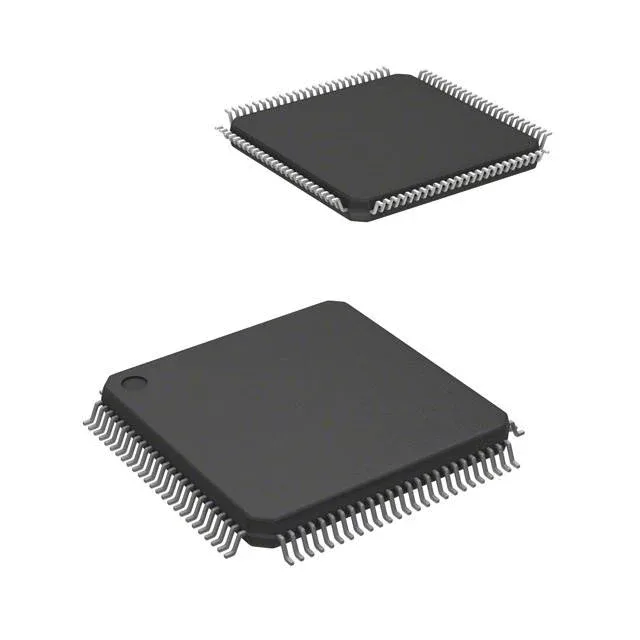
80 MHz Cortex-M3 with 256 KB flash — what the memory and speed mean for a control-loop design
The LM3S9B81-IQC80-C3T: The LM3S9B81 runs the ARM Cortex-M3 core at 80 MHz, giving a throughput of roughly 100 MIPS from the flash — enough to service a CANopen stack, a TCP/IP lightweight stack, and a PID loop on a single interrupt priority without starving the scheduler. 256 KB of on-chip flash and 96 KB of SRAM mean the firmware image can hold a full Ethernet bootloader plus application code, with the SRAM buffering a 1.5 KB Ethernet frame several times over before DMA moves it to a peripheral buffer.
Connectivity set — CAN, Ethernet, USB OTG, and five serial channels
The part integrates CAN, Ethernet MAC+PHY, USB OTG, plus I²C, SPI, SSI, UART, IrDA, LIN, and Microwire — covering the fieldbus and debug interfaces needed for an industrial gateway or motor-drive control board without external bridge chips. The external bus interface (EBI/EMI) can expand memory or connect an FPGA, though the 100-LQFP limits the available address lines compared to a BGA package.
Industrial temperature range and supply rails
Rated for -40 to 85 °C ambient, the part suits enclosures without active cooling — a panel-mounted controller in a factory bay or an outdoor telecom pedestal stays within the operating envelope. The core supply is a tight 1.235-1.365 V, which means a dedicated LDO or switching regulator is required — the I/O bank runs separately from the core rail, so a single 3.3 V supply needs a downstream regulator for the Vcore domain.