Stellaris LM3S9B81 — 80 MHz Cortex-M3 with Ethernet and CAN
The LM3S9B81-IQC80-C3: This MCU was designed for networked industrial control, building automation, and gateway applications where wired connectivity is central.
There is no official TI successor listed for this exact order code. For new designs, a pin-compatible alternative within the same family is not available from the original manufacturer. Buyers should verify date-code consistency and packaging condition when procuring from the surplus market.
80 MHz Cortex-M3 — what the core speed means
The 80 MHz ARM Cortex-M3 core delivers a balance of throughput and power efficiency for real-time control and protocol processing. At this clock rate, the part can handle a TCP/IP stack, CAN message handling, and USB device/host operation without external protocol chips. The 96 KB SRAM provides enough buffer space for Ethernet frames and CAN message objects, while the 256 KB Flash accommodates a moderate application with a real-time OS. The core supply operates from 1.235 V to 1.365 V, which is a narrow range — the board-level regulator must be accurate to avoid brown-out resets.
Peripheral set — Ethernet, USB OTG, CAN, and more
The LM3S9B81 integrates a 10/100 Ethernet MAC with an integrated PHY, a USB OTG controller, and two CAN 2.0 controllers, making it suitable for industrial gateways, protocol converters, and networked sensor hubs. The 65 GPIOs are sufficient for driving a local display, keypad, and status LEDs alongside the communication interfaces. The part also includes a 16-channel 10-bit ADC, PWM outputs, and a watchdog timer.
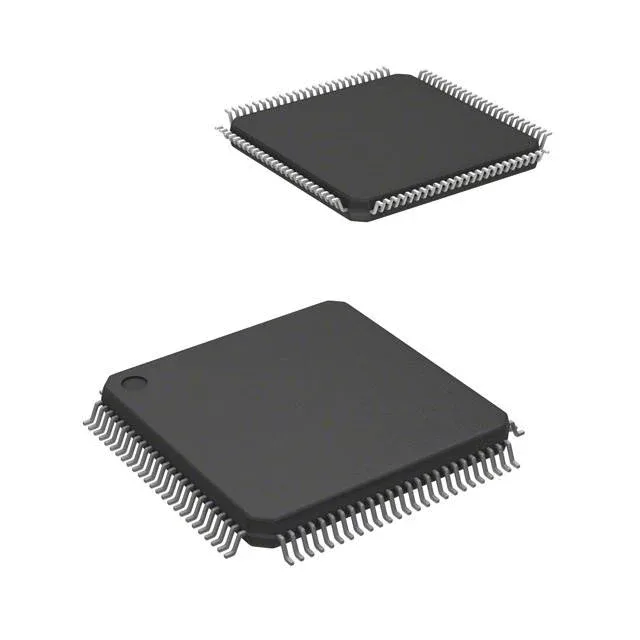
The device is housed in a 100-pin LQFP with a 14 mm × 14 mm body, suitable for standard reflow assembly.