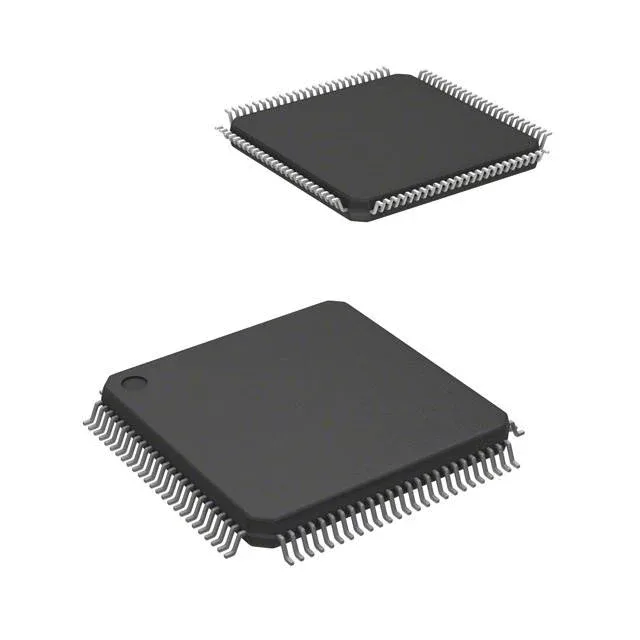
The part is built for industrial control and embedded networking: its peripheral set includes a 10/100 Ethernet MAC, two CAN 2.0B controllers, USB OTG, multiple UART/SPI/I²C serial ports, plus a quadrature encoder interface for motor feedback.
The 80 MHz core clock is the headline rating for this MCU. At this speed the Cortex-M3 can handle a real-time control loop (say, a motor FOC update at 10 kHz) alongside a TCP/IP stack and CAN message handling without saturating the CPU. The single-cycle multiply and hardware divide help keep interrupt latency predictable. If your application only needs 48 MHz, the PLL can divide down, but the full 80 MHz is there when the protocol stack or sensor fusion demands it.
Ethernet, CAN, USB — the connectivity mix
What sets this part apart from simpler Stellaris siblings is the simultaneous Ethernet MAC, dual CAN controllers, and USB OTG on one die. The EBI/EMI interface also allows glueless connection to external SRAM or Flash if the on-chip 128 KB runs out. For designs that need both fieldbus and factory-floor networking, this peripheral mix saves an external communications co-processor.
The separate core and I/O voltage domains mean the 3.3 V peripheral rail stays independent of the core regulator.
There is no official direct-replacement order code listed in the Stellaris 9000 series; the Stellaris line was acquired by TI and later phased out in favour of the Tiva C and TM4C families. No stock or price figures are published here because the spot market moves daily.