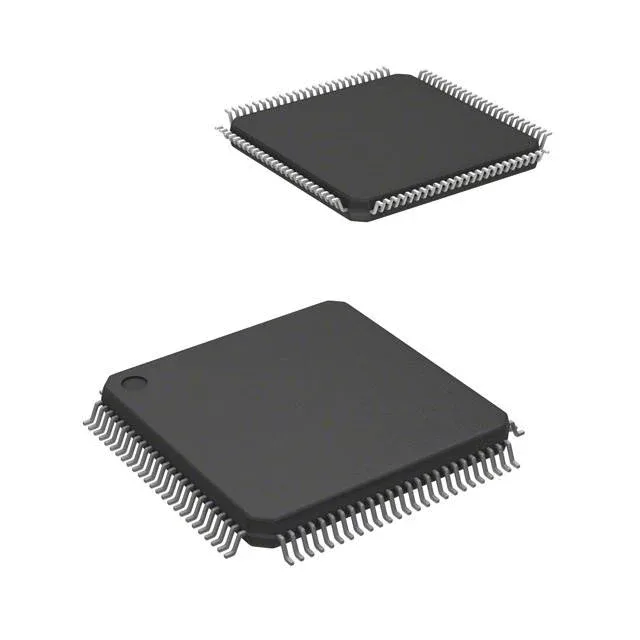
Texas Instruments LM3S8971-IQC50-A2T — Microcontrollers & Processors (MCU / MPU / DSP)

LM3S8971-IQC50-A2T Stellaris ARM Cortex-M3 MCU, 50 MHz

MPNLM3S8971-IQC50-A2T
Obsolete

Texas Instruments Stellaris® ARM® Cortex®-M3S 8000 series LM3S8971-IQC50-A2T, 32-bit MCU, 50 MHz, 256KB Flash, 64K x 8 RAM, Ethernet & CAN, 38 I/O, 8x10b ADC, -40°C~85°C, 100-LQFP.

Sourced new & surplus through independent channelsAuthenticity-screened · ESD-safe packingListing updated Jul 2026

Specifications

LM3S8971-IQC50-A2T specifications
ParameterValue
SeriesStellaris® ARM® Cortex®-M3S 8000
MountingSurface Mount
Oscillator typeInternal
Program memory typeFLASH
Voltage - supply (Vcc (Vdd))2.25V ~ 2.75V
Operating temperature-40°C~85°C(TA)
Speed50MHz
PackageTape & Reel (TR)
RAM size64K x 8
Core size32-Bit Single-Core
PeripheralsBrown-out Detect/Reset, POR, PWM, WDT
ConnectivityCANbus, Ethernet, IrDA, Microwire, QEI, SPI, SSI, UART/USART
Number of i (O)38
Core processorARM® Cortex®-M3
Case100-LQFP
Data convertersA/D 8x10b
Program memory size256KB (256K x 8)

Product details

It was built for industrial and building-control applications that need both Ethernet and CAN connectivity on a single chip — think programmable logic controllers, HVAC gateways, motor drives, and remote I/O nodes that talk over a factory network and a local sensor bus simultaneously. The part includes an 8-channel 10-bit ADC, PWM timers, a quadrature encoder interface, and multiple serial ports (UART, SPI, SSI, Microwire, IrDA), so it could handle sensor fusion, closed-loop motor control, and HMI communication without external interface ICs.

The LM3S8971-IQC50-A2T is officially marked obsolete. Texas Instruments ended production on the Stellaris line after acquiring Luminary Micro and migrating designs to the Tiva C series. For a BOM that already carries this MCU, the only sourcing path is the independent distribution channel — new-old-stock, surplus inventory, or broker-sourced units. Any stock found today is what remains in the channel; no further factory orders are possible.

50 MHz Cortex-M3 — the performance tier and what it can handle

The 50 MHz ARM Cortex-M3 core delivers about 1.25 DMIPS/MHz, so roughly 62.5 DMIPS peak. That is enough for a real-time control loop with Ethernet packet processing and CAN message handling running concurrently — think a motor drive that streams status over Modbus TCP while responding to CANopen position commands. The 38 GPIOs in the 100-pin LQFP package leave room for a parallel LCD interface or a bank of optocoupled digital inputs alongside the serial peripherals.

Supply voltage and package — board-level constraints

That means a dedicated 2.5 V rail or an LDO from 3.3 V is needed on the board — the I/O pins are not 5 V tolerant.

Frequently asked questions

Where can I buy LM3S8971-IQC50-A2T available via RFQ confirmation?

The LM3S8971-IQC50-A2T is obsolete and no longer in factory production.

Is LM3S8971-IQC50-A2T obsolete?

Yes, the LM3S8971-IQC50-A2T is officially obsolete. Texas Instruments discontinued the Stellaris line after acquiring Luminary Micro. No further factory orders are accepted; any procurement must go through surplus or broker inventory.

What is the replacement for LM3S8971-IQC50-A2T?

There is no pin-compatible drop-in replacement from Texas Instruments. The Tiva C series (TM4C123x) is the architectural successor but uses a 3.3 V supply and a different pinout. A redesign with a TM4C123GH6PM or an equivalent Cortex-M4 part from STMicroelectronics (STM32F4 series) or NXP (LPC1768) would be needed. For keeping an existing board running, the only option is sourcing the original LM3S8971 from the surplus channel.

What are the specifications of LM3S8971-IQC50-A2T?

It has 256 KB Flash, 64 KB SRAM, 38 GPIOs, an 8-channel 10-bit ADC, and integrated Ethernet MAC and CAN 2.0B controllers. Connectivity includes CANbus, Ethernet, IrDA, Microwire, QEI, SPI, SSI, and UART/USART.