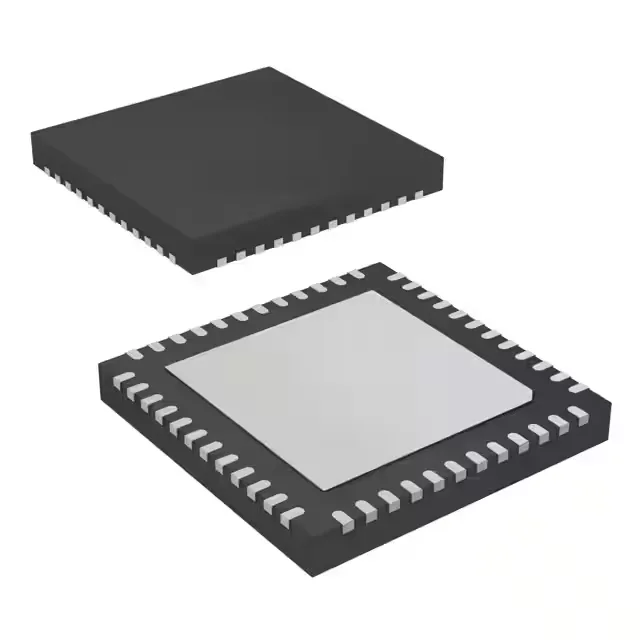
ARM Cortex-M3 at 50 MHz — what the core delivers
That core clock, combined with a single-cycle multiply and hardware divide, gives it enough headroom for real-time control loops — motor commutation, sensor fusion, or protocol bridging — without needing an external DSP. The 64 KB of on-chip Flash and 8 KB SRAM are sized for mid-complexity firmware: a bootloader, a RTOS kernel, and a few peripheral drivers fit without squeezing.
Peripheral set and I/O — what connects where
The connectivity block includes I²C, SPI, SSI, Microwire, and UART/USART — enough to talk to serial Flash, external ADCs, display modules, and RS-485 transceivers on the same chip. An internal oscillator keeps the core running without an external crystal, though the clock tree also accepts an external source if tighter timing is needed.
Built-in ADC — eight channels, 10-bit resolution
An eight-channel, 10-bit successive-approximation ADC is integrated on-die. That covers most analog-front-end tasks in industrial control — reading potentiometers, current-sense resistors, or thermistor dividers — without an external converter. The 10-bit resolution is adequate for 0.1% measurement over a 3.3 V reference; if your application needs 12 bits or differential inputs, you will need an external ADC.
For dual-sourcing resilience, the Stellaris family includes several pin-compatible density variants — a buyer can qualify a second Flash/RAM tier without a board respin.