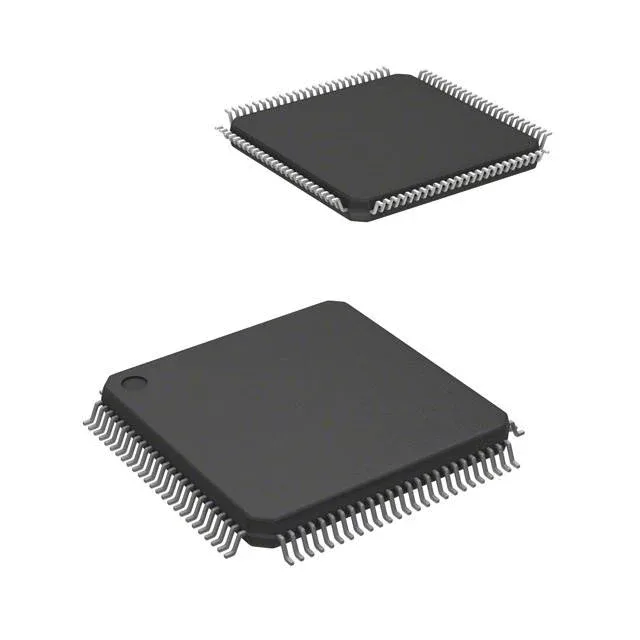
What the Stellaris LM3S6C11 brings to a control-plus-connectivity design
It integrates an Ethernet MAC controller alongside a full suite of serial interfaces — I2C, SPI, SSI, UART, IrDA, LIN, and Microwire — making it a single-chip node for industrial automation, building control, or IoT gateway designs that need a network stack without an external PHY-management processor.
The 80 MHz core is fast enough to run a lightweight TCP/IP stack (lwIP or similar) and handle Modbus TCP or EtherNet/IP polling without a separate network coprocessor. The on-chip Ethernet MAC eliminates the cost of an external controller IC and its associated glue logic — just add an external PHY chip and magnetics. The 512 KB flash leaves headroom for a bootloader, application firmware, and a small file system; the 64 KB SRAM is adequate for packet buffers and a modest RTOS heap. If your design needs more RAM for large data logs or a full web server, the LM3S6C11 sits at the lower end of the Stellaris Ethernet family — higher-density siblings double the SRAM.
Package and supply rails — layout notes
The LM3S6C11 comes in a 100-LQFP with a 14x14 mm body and 0.5 mm pitch — a hand-solderable fine-pitch QFP that routes easily on a two-layer board if you keep the trace lengths short. Supply voltage is 3.0 V to 3.6 V nominal, so a single 3.3 V rail powers the core and I/O. The internal oscillator can serve as the system clock, but for Ethernet operation an external 25 MHz crystal is typical to feed the MAC's PLL. The 46 I/O are 5 V tolerant on most pins, which simplifies level translation when interfacing to legacy 5 V peripherals.