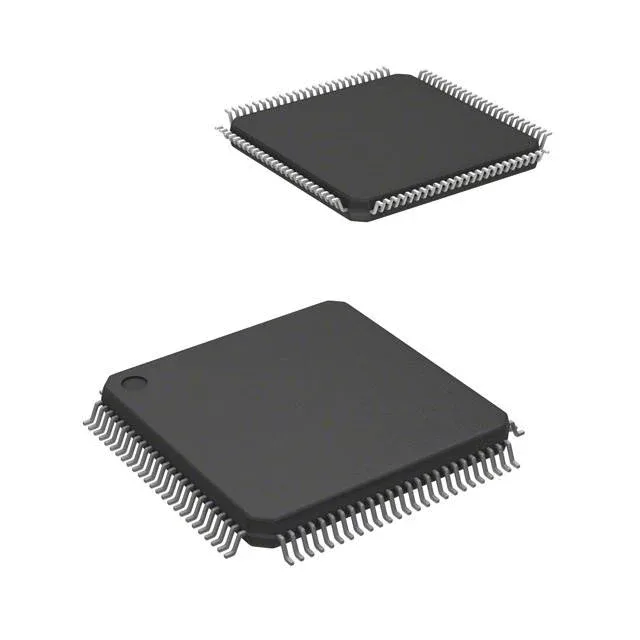
What this Stellaris Cortex-M3 brings to the board
The 100-LQFP package keeps routing manageable on a two-layer board, and the industrial temperature range (-40 to 85°C) means it survives unventilated enclosures and outdoor cabinets.
At 50 MHz the Cortex-M3 executes most instructions in a single cycle, so a PID loop or Modbus frame handler runs with deterministic timing. The 64 KB SRAM gives you room for a few kilobytes of packet buffer plus the stack and heap; if your application streams data continuously, budget the DMA usage against that pool. The 256 KB Flash holds a full RTOS image plus the application — no need for external storage unless you are logging large datasets.
Ethernet MAC — what is and is not on die
The LM3S6938 includes an Ethernet MAC controller, but you still need an external PHY chip and magnetics to reach the RJ45. The MAC interfaces via MII or RMII, so pick a PHY that matches your preferred bus width and clock scheme. The other serial peripherals (I²C, SPI, SSI, UART) share pins with the GPIO bank — the 38 available I/O lines get allocated quickly once Ethernet, a debug UART, and a sensor bus are assigned.
No last-time-buy notice has been issued, and the supply channel supports both new design-ins and ongoing production replenishment. For MRO buyers pulling a failed unit off a legacy board, this means a direct drop-in replacement is available without requalifying a second source.
Package and power supply realities
Brown-out detect and POR are integrated, which simplifies the power-on sequencing. The internal oscillator gets you running quickly, but for Ethernet timing you will want an external crystal or oscillator on the main clock input.