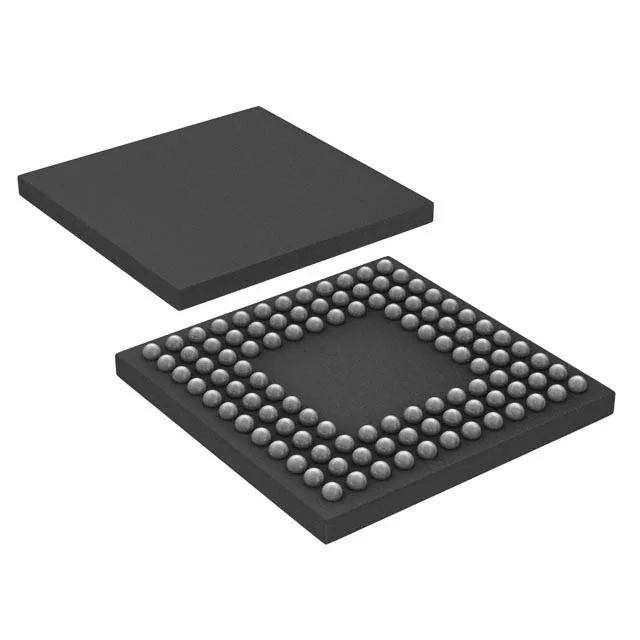
The LM3S6753-IBZ50-A2: The Cortex-M3 core runs at 50 MHz, delivering roughly 1.25 DMIPS/MHz — about 62.5 DMIPS — which is sufficient for moderate protocol stacks and control loops without external memory wait states. 128 KB of on-chip flash (128K x 8) and 64 KB SRAM (64K x 8) mean a TCP/IP stack with a small RTOS leaves about 40–50 KB free for application code and data buffers, assuming a lean Ethernet driver. The 2.25 V to 2.75 V supply range is narrower than the 3.3 V typical for many Cortex-M3 parts — the board must regulate to 2.5 V nominal, and the BOM should account for a dedicated LDO if the system rail is 3.3 V.
Peripheral set and connectivity — Ethernet plus serial flexibility
Integrated Ethernet MAC with MII/RMII interface, alongside I²C, SPI, SSI, UART/USART, IrDA, Microwire, and QEI — this peripheral mix suits industrial gateways, motor-control encoders, and sensor hubs that need both wired networking and multiple serial buses. The 4-channel 10-bit ADC (A/D 4x10b) is adequate for slow analog monitoring (temperature, voltage sense) but not for high-speed data acquisition — the 10-bit resolution and likely sub-1 Msps sample rate limit it to DC or low-frequency signals. 41 general-purpose I/O pins in the 108-BGA package — enough for a parallel LCD interface, keypad matrix, and a few external peripherals without a port expander.
Package, temperature grade, and board integration
Surface-mount assembly with standard lead-free reflow profile; the BGA's 0.8 mm pitch is within the capability of most pick-and-place lines, but X-ray inspection is recommended after reflow to catch head-in-pillow defects on the center balls.