What this Stellaris MCU brings to a design
It integrates an Ethernet MAC alongside I²C, SPI, SSI, UART, IrDA, and Microwire serial interfaces, plus a 4-channel 10-bit ADC and PWM timers.
50 MHz Cortex-M3 – enough for control and protocol stacks
At 50 MHz the ARM Cortex-M3 core delivers around 1.25 DMIPS/MHz, so you get roughly 62.5 DMIPS. That is comfortable for running a lightweight TCP/IP stack (lwIP or uIP) while handling a motor-control loop or sensor polling. The 128 KB Flash holds a moderate application plus a bootloader; the 32 KB SRAM leaves room for Ethernet packet buffers and a modest heap.
Ethernet MAC – the standout peripheral
The integrated Ethernet MAC is the feature that sets this MCU apart from plain serial-interface parts. It supports 10/100 Mbps with MII/RMII, so you can connect a low-cost PHY (e.g., DP83848 or LAN8720) and get a node on an industrial network. The 41 GPIOs are enough to drive a small display, keypad, and status LEDs alongside the Ethernet interface. Just watch the pin sharing – the Ethernet RMII pins overlap with some GPIO and other peripherals, so check the pin assignment in the datasheet before committing the schematic.
No new production is running; the only supply channel is surplus inventory and broker stock. If your BOM still calls out this exact order code, you will need to source through independent distribution. For a long-term production program, plan a migration to a current Stellaris or Tiva-C family part (pin-compatible options exist within the same 100-LQFP footprint).
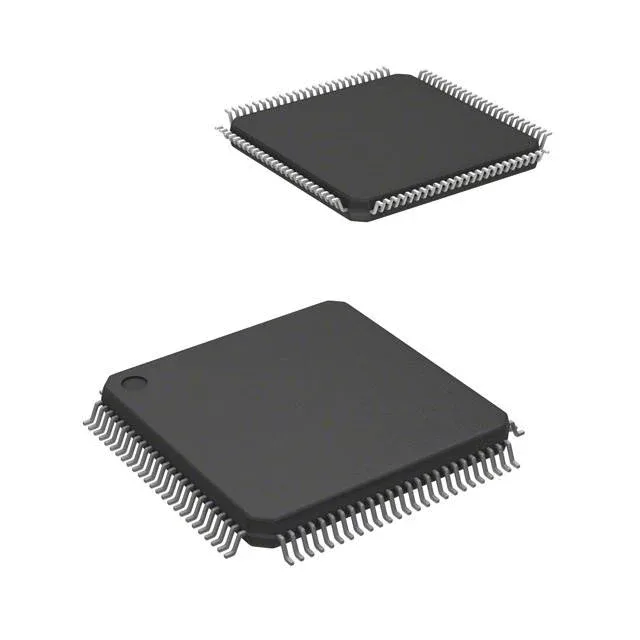
Package and footprint – 100-LQFP 14x14 mm
It is a standard fine-pitch QFP – reworkable with a hot-air station but not a field-swap candidate without a controlled environment. Decouple with a 0.1 µF cap near each VDD/VSS pair and a bulk 10 µF on the board.