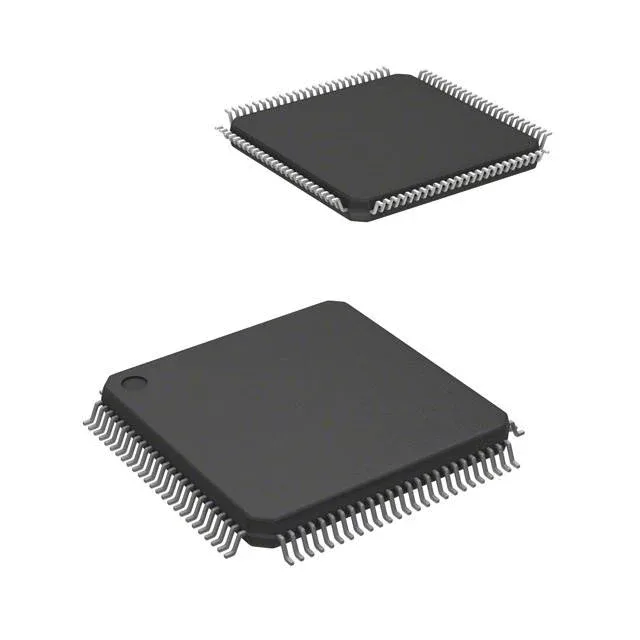
50 MHz Cortex-M3 — processing budget and bus margin
The 50 MHz core speed, combined with the 32-bit ARM Cortex-M3 architecture, delivers a predictable 1.25 MIPS/MHz throughput. For a design handling a TCP/IP stack alongside real-time I/O, this means the firmware team needs to budget interrupt latency and context-switch overhead early — the 50 MHz ceiling is adequate for moderate-throughput Ethernet applications but leaves no headroom for heavy DSP or graphics. If the application code plus a lightweight IP stack exceeds 80 KB of Flash, or the data buffers consume more than 20 KB of RAM, the engineer should consider a higher-density sibling before committing the BOM.
Pair it with an external PHY (e.g., DP83848) and a magnetics module. The 41 GPIOs remain available for parallel buses, discrete I/O, or additional serial channels after the Ethernet interface is wired.
Peripherals and data conversion
On-chip peripherals include brown-out detection, power-on reset, PWM outputs, and a watchdog timer — enough for standalone operation without external supervisory ICs. The 4-channel 10-bit ADC covers basic analog sensing (temperature, current, voltage monitoring) but is not suited for precision instrumentation or high-speed data acquisition.
Obsolete — sourcing and replacement strategy
The official lifecycle status is Obsolete. Texas Instruments has discontinued this exact order code, and no direct pin-compatible replacement is recorded in the available documentation.