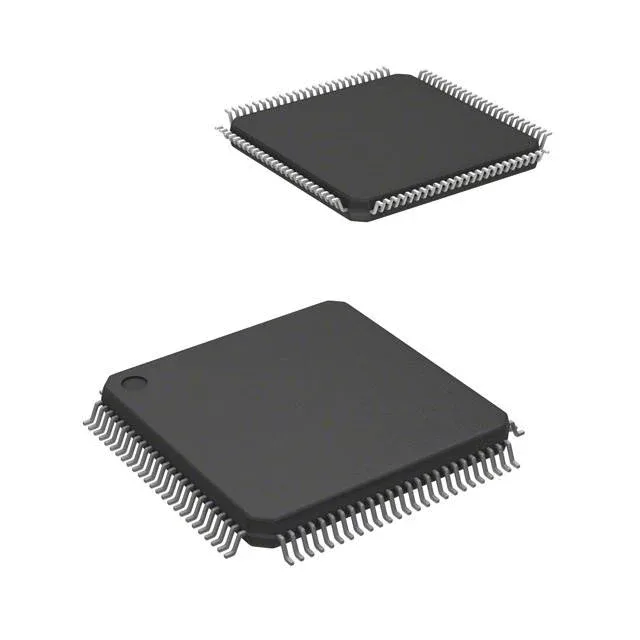
What this Stellaris MCU brings to an industrial Ethernet node
The 8-channel 10-bit ADC and 38 general-purpose I/O lines handle local sensor acquisition and actuator control alongside the Ethernet stack.
TI formally discontinued the Stellaris line after acquiring Luminary Micro; no official direct replacement exists within the current TI portfolio. Any new design should look at current Cortex-M4 or M7 parts with integrated Ethernet, such as the TM4C129 series (also from TI), but those require a board respin due to different pinout and peripheral map.
50 MHz core and 128 KB Flash — sizing the firmware budget
The 50 MHz Cortex-M3 delivers about 1.25 DMIPS/MHz, or roughly 62 DMIPS total — enough for a lightweight TCP/IP stack (lwIP or uIP) plus a Modbus/TCP or EtherNet/IP adapter application without CPU saturation. The 128 KB Flash is the hard limit for the combined bootloader, protocol stack, and application image; if your firmware exceeds 120 KB after compression, you will need a larger-Flash sibling (the LM3S6918, also 128 KB but with more RAM) or a different family. The 32 KB SRAM leaves about 20 KB for packet buffers and runtime data after the stack overhead, so avoid jumbo-frame or high-throughput logging without external SRAM.
Ethernet MAC+PHY — no external PHY needed
The integrated Ethernet MAC and PHY is the differentiator. It supports 10/100 Mbps with auto-negotiation and a Media Independent Interface (MII) that also allows an external PHY if needed. The internal PHY saves board area and BOM cost, but the analogue portion is sensitive to supply noise — keep the 2.5 V analogue rail clean with a ferrite bead and 10 µF cap near the VDDA pin, as recommended in the Stellaris reference design. The Ethernet block also includes a dedicated DMA controller that offloads packet handling from the CPU.
This is unusual — most Cortex-M3 MCUs run at 3.3 V or 1.8 V core with 3.3 V I/O.
Industrial temperature range — rated for the factory floor
The 100-LQFP package is a standard JEDEC outline, so rework with a hot-air station is straightforward — no BGA underfill or X-ray inspection needed.