What this Cortex-M3 brings to a networked control design
Three 10-bit ADC channels handle analog feedback from sensors or potentiometers.
50 MHz core and memory — sizing the firmware and data buffers
The 50 MHz Cortex-M3 delivers about 1.25 DMIPS/MHz, so you get roughly 62.5 DMIPS — enough for a lightweight RTOS, a TCP/IP stack with a few sockets, and a PID loop running at a few kilohertz. The 96 KB Flash holds the firmware image; if your application needs a bootloader plus a full Ethernet stack plus a control algorithm, check the linker map early — 96 KB fills faster than you expect once you add lwIP or a similar stack. The 32 KB SRAM splits between code data, stack, and packet buffers; a single Ethernet frame at 1518 bytes plus a few TCP sockets can eat 8–12 KB, leaving room for the control variables.
The integrated Ethernet MAC saves a separate controller chip and its associated crystal and magnetics interface. You still need an external PHY (e.g., a DP83848 or LAN8720) and a set of RJ45 magnetics, but the MAC-to-PHY connection is a standard MII or RMII bus — four to eight signals plus a clock. The part also includes IrDA, Microwire, and SSI, which are less common on Cortex-M parts; if your design uses one of these legacy serial protocols, this MCU saves a level-shifter or a separate UART bridge. The 43 GPIOs are enough to drive a small LCD, a keypad, and a few status LEDs alongside the serial interfaces.
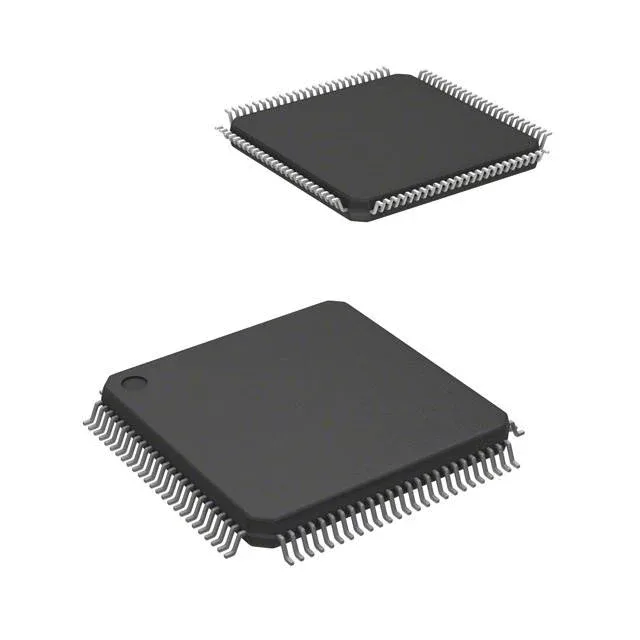
Package and footprint — 100-LQFP layout notes
That is a common footprint for mid-density MCUs — the board area is manageable, but the fine pitch means via-in-pad is not required; a standard dogbone fanout with 0.3 mm traces and 0.5 mm vias works. The internal oscillator is available, but for Ethernet operation an external 25 MHz crystal is typical to clock the MAC and PHY.
Lifecycle and supply — active, no LTB risk
The Stellaris family has been transitioned to the TM4C series at TI, but this specific order code remains active; if you need a second-source or a migration path, the TM4C123GH6PM is a pin-compatible Cortex-M4F with more Flash and a floating-point unit, though it runs on a 3.3 V supply instead of 2.5 V.