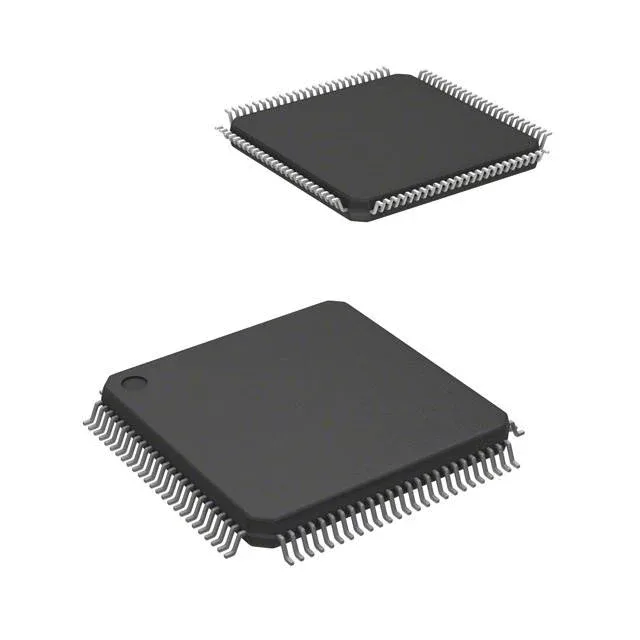
What this Stellaris MCU brings to a networked control board
The 100-LQFP package provides 34 general-purpose I/O lines, two 10-bit ADC channels, and on-chip oscillators, so many designs can run without external clock components.
Obsolete — planning the BOM transition
For a production BOM that currently uses the LM3S6422, the practical path is either a last-time-buy buy to cover remaining builds or a qualification of a different Stellaris or Tiva-C family member that matches the 100-LQFP footprint and peripheral set — expect a firmware port and possibly a board respin.
25 MHz core — enough for what this part was designed for
The 25 MHz Cortex-M3 core delivers around 0.8 DMIPS/MHz, so roughly 20 DMIPS available. That is comfortable for a control loop reading a few ADC channels and managing an Ethernet stack with lightweight TCP/IP; it will not run a Linux-class OS or heavy DSP. The 32 KB RAM is the real constraint — the Ethernet buffer and application heap share that space, so firmware must be lean.
Ethernet on-chip — the feature that defines the use case
The integrated Ethernet MAC/PHY is the standout peripheral. It saves an external PHY chip and the associated PCB routing, which is why this part was popular in cost-sensitive networked products like programmable logic controllers and remote I/O modules. The other serial interfaces (SPI, SSI, UART, IrDA, Microwire) cover most sensor and actuator links. The two 10-bit ADC channels are basic — adequate for monitoring voltages or currents, not precision analog.