Connectivity options cover I²C, SPI, SSI, Microwire, and UART/USART interfaces.
At 50 MHz the Cortex-M3 core delivers roughly 1.25 DMIPS/MHz, or about 62.5 DMIPS. That is enough for moderate control loops, protocol stacks (TCP/IP offload not needed), and real-time sensor fusion. The Flash memory requires zero wait states at this clock speed, so instruction fetch does not stall — a practical advantage over higher-clocked parts that need wait-state insertion.
The Flash can hold a modest application — a bootloader, a few communication stacks (I²C, UART), and application code. The 8 KB RAM (organized as 8K x 8) supports a handful of buffers and a small RTOS heap. If your firmware needs more than 20 KB of code space or 4 KB of runtime data, this part will feel tight; consider a sibling with larger memory.
No last-time-buy window or successor part number is recorded in the official lifecycle data. If you are designing a new product, look at TI's current Cortex-M4 or M0+ families in a 48-LQFP footprint for a pin-compatible path forward.
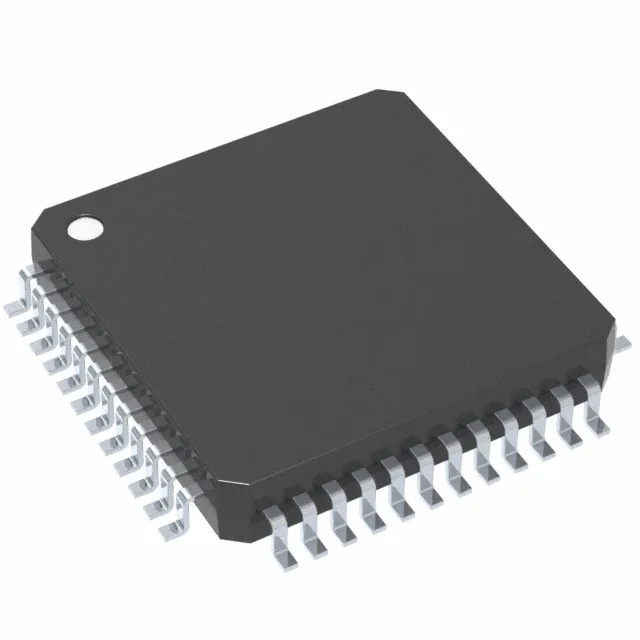
Package and footprint — 48-LQFP (7x7 mm)
It is a common footprint shared by many Stellaris and later TI ARM MCUs, which simplifies board reuse when migrating. The 28 I/O lines are available on the outer leads; no exposed pad is present, so thermal dissipation relies on the leadframe and board copper.