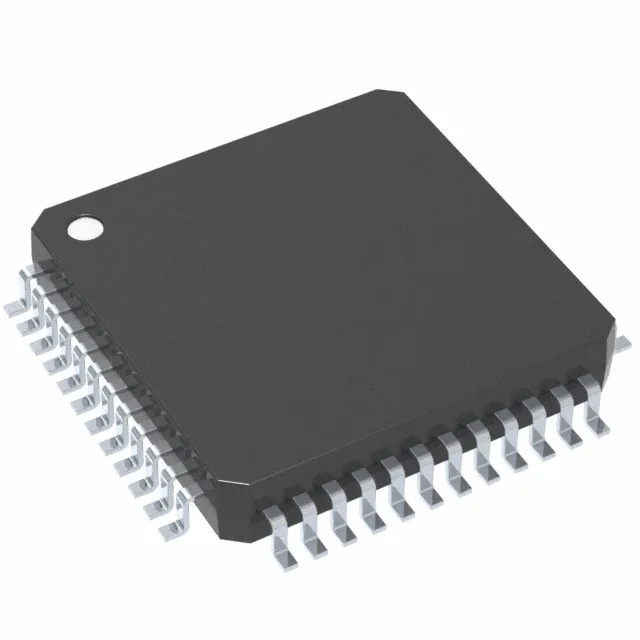
Obsolete — plan your last-time-buy or alternate now
50 MHz Cortex-M3 — what the core speed means for your application
The 50 MHz ARM Cortex-M3 core places this MCU in the mid-range performance tier for control-loop and sensor-fusion tasks. At this clock rate, the single-cycle multiply and hardware divide handle PID loops, encoder decoding, and basic digital filtering without needing a separate DSP. The 32-bit data path processes 32-bit sensor words and 32-bit timer values in one cycle, which matters when you are counting edges from a 10,000-line encoder or accumulating ADC samples without overflow. For a design that needs deterministic interrupt response — the Cortex-M3 tail-chaining and late-arrival features keep jitter under a dozen cycles — this core is a known quantity.
Memory budget: 32 KB Flash, 8 KB RAM
The Flash is sufficient for a modest RTOS kernel (FreeRTOS or TI-RTOS), a USB stack, and application code for a motor drive or sensor hub — but not for a GUI or file system. The 8 KB RAM must be budgeted carefully: a 1 KB stack, 2 KB for communication buffers, and the rest for global variables and peripheral DMA descriptors. If your application needs over-the-air firmware updates, the 32 KB Flash leaves little room for a dual-bank bootloader; consider a larger Flash sibling in the Stellaris family.
The 8-channel 10-bit ADC samples at rates suitable for current sensing and temperature monitoring, not high-speed data acquisition. Brown-out detect and POR are integrated, so external reset supervision is optional for cost-sensitive boards.