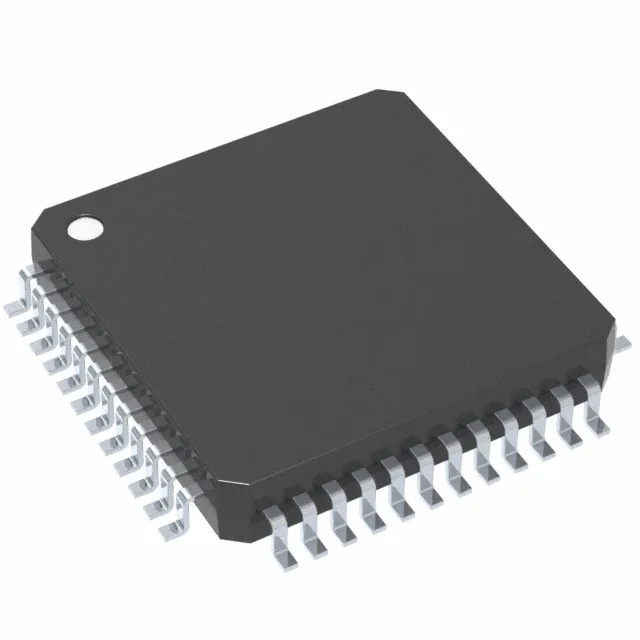
TI is not actively pushing this into new sockets, though existing production runs may still be fulfilled through the channel. For a BOM that already specifies this part, the sourcing strategy shifts to securing inventory before the last-time-buy window closes or relying on independent distribution for bridge quantities. This is not an obsolete part today, but the clock is running — any new design should evaluate a current-production alternate before committing the layout.
Memory sizing — 32 KB Flash, 8 KB RAM
This part is sized for a dedicated control task — a single protocol stack (UART/SPI-based), a PID loop, and a handful of configuration parameters — not a Linux-class application. The 8 KB RAM will be tight if you are buffering large serial packets or running a full RTOS with multiple stacks; budget carefully if your firmware uses dynamic allocation. The Flash endurance is not stated here, but the Stellaris family typically supports 100k write/erase cycles, adequate for field-updatable firmware if wear-leveling is implemented.
Connectivity and peripherals for sensor and motor interfaces
The LM3S618 integrates UART, SPI, SSI, and Microwire serial interfaces, plus a Quadrature Encoder Interface (QEI) for reading motor position or rotary encoders. The 6-channel 10-bit ADC samples analog signals like thermistor inputs or current-sense voltages. The Brown-out Detect/Reset and POR circuits mean the MCU starts cleanly on power-up and resets if the supply dips — no external supervisor needed for basic reliability. An internal oscillator is on-die, so a crystal is optional for applications that can tolerate the internal accuracy.
Package and footprint — 48-LQFP (7x7 mm)
The 0.5 mm pitch means the PCB fab needs standard capability — no micro-vias or blind vias required.