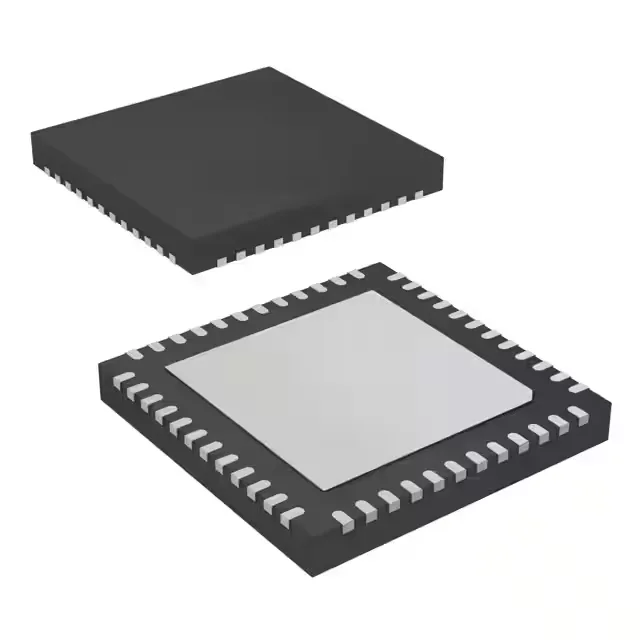
What this Cortex-M3 brings to a control board
At 50 MHz the Cortex-M3 executes most single-cycle instructions, so a tight control loop or a protocol state machine runs without waiting on the bus. The internal oscillator means you can bring up the UART and start talking to a host before an external crystal is even populated — handy for a field swap where the kit might not have the exact can.
Memory budget: 32 KB Flash, 8 KB RAM
32 KB of Flash holds a modest firmware image — think a bootloader plus one application layer, not a full RTOS with a TCP/IP stack. The 8 KB RAM is the working memory ceiling; if your design queues CAN messages or buffers UART streams, check that the stack and heap fit within that 8 KB before committing the BOM. For a motor-control or sensor-interface project the headroom is usually fine; for a GUI or logging application you will feel the squeeze.
Industrial temperature grade and on-chip supervision
Package and thermal pad
Without that via pattern the junction temperature climbs faster under continuous load. The pad is also the only ground return for the die, so the PCB layout must connect it solidly to the system ground.