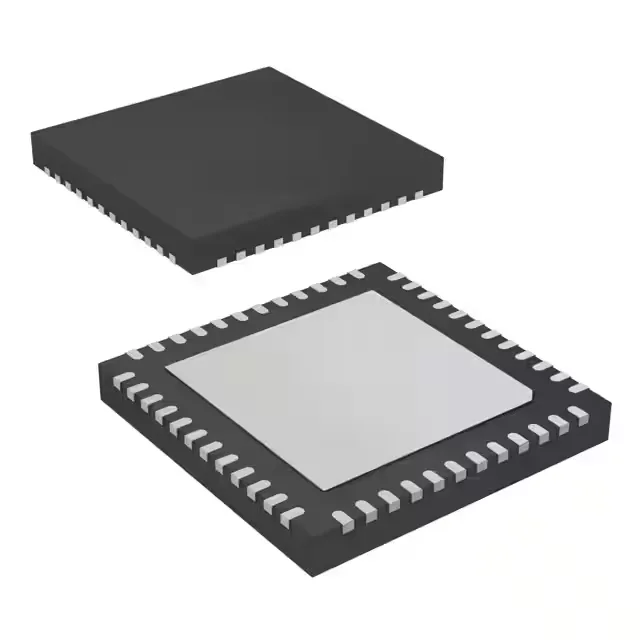
50 MHz Cortex-M3 with 32 KB flash — what the memory budget means
The LM3S601-EGZ50-C2: That core speed handles real-time control loops — think sensor fusion, motor commutation, or protocol parsing — without needing an external co-processor. On-chip memory is 32 KB of flash and 8 KB of SRAM. The flash holds the application plus a bootloader; the SRAM covers the stack, heap, and a few frame buffers. For a UART-to-SPI gateway or a brushless-DC controller, that is enough headroom. If the firmware image pushes past 28 KB, you will need to look up the family for a larger flash variant.
Industrial temperature grade and peripheral set
Connectivity includes I²C, SPI, SSI, UART/USART, Microwire, and a quadrature encoder interface (QEI). That QEI block is the reason this part shows up in servo drive and conveyor feedback designs — it decodes the A/B/I signals from an incremental encoder without bit-banging GPIOs. The 36 GPIOs leave room for a parallel LCD or a keypad matrix alongside the serial buses. On-chip peripherals include brown-out detect, POR, PWM, and a watchdog timer. The internal oscillator means you can bring up the UART without an external crystal, though the accuracy is good enough for asynchronous serial, not for a CAN node without a resonator.
Housed in a 48-VFQFN with an exposed pad (7x7 mm body). Without that, the junction temperature rises 20-30°C above the ambient under continuous 50 MHz operation. Surface-mount only; the VQFN package is not hand-solderable without a hot-air station and a stencil. For prototyping, a QFN breakout board with the correct pad pattern is the practical route.