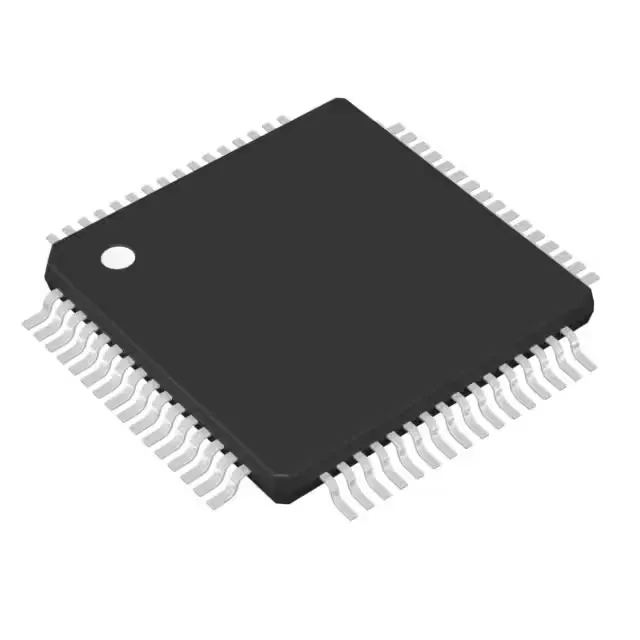
80 MHz Cortex-M3 with 128 KB Flash — what you get
The 8-channel 10-bit ADC and PWM timers suit it for closed-loop control in industrial drives, pump controllers, and building automation gateways.
Obsolete — last-time-buy reality
Any new design should migrate to a current-generation Cortex-M4 or M33 part with a compatible peripheral set; for existing BOM lines, the priority is securing enough units to cover the remaining build window before channel inventory dries up.
Peripheral fit — USB and CAN on a single chip
The USB interface (device/host/OTG) and CAN 2.0B controller on the same die are the standout integration for this class. A single LM3S5K36 can bridge a CAN-based sensor network to a USB host for data logging or firmware updates, saving a separate USB-to-CAN dongle and its associated BOM cost. The 24 KB SRAM is tight for large USB buffers — plan the endpoint descriptor allocation carefully if you are running a composite device.
Supply rail — 1.08 V to 1.32 V core
The core logic runs from a 1.08 V to 1.32 V supply, which is narrower than the typical 3.3 V-only MCU. The board needs a dedicated 1.2 V regulator with tight tolerance (±2 % or better) — a standard 1.2 V LDO with 1 % initial accuracy works, but watch the dropout at low input voltage. The I/O ring is powered separately (VDDIO, typically 3.3 V), so level translation between the core and peripherals is handled internally.