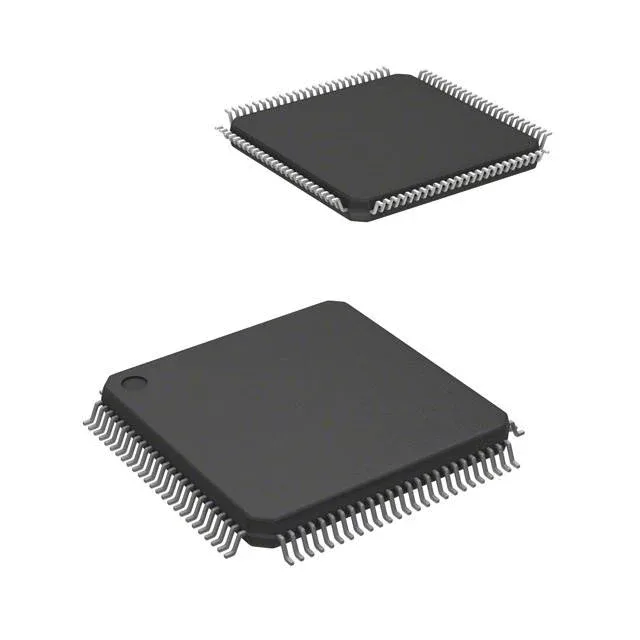
The LM3S5K31-IQC80-C0: The core runs from a 1.08 V to 1.32 V supply rail, which means a dedicated low-voltage regulator is required on the board — the same rail that powers the Cortex-M3 core on other Stellaris parts, so the power tree is familiar if you have designed with the family before.
The 24 KB of SRAM handles a couple of moderate-sized data buffers and a RTOS kernel with a few tasks — plan the heap and stack allocation early in the firmware design.
Sourcing is limited to the independent distribution market — surplus inventory, new-old-stock, and broker channels. There is no pin-compatible drop-in replacement announced by TI for this specific order code.
Connectivity and peripherals — what the interfaces support
The CAN 2.0B controller makes this MCU a natural fit for industrial automation nodes, motor drives, and automotive-adjacent control modules that communicate over a CAN bus. The USB interface (device or host, depending on the PHY) handles data logging or firmware updates through a USB stick. The QEI (quadrature encoder interface) directly decodes incremental encoder signals for closed-loop motor position feedback without external logic. The 16-channel 10-bit ADC samples analog sensors — thermistors, potentiometers, current shunts — at a resolution adequate for control loops that do not require 12-bit or higher precision.
The 100-LQFP package is not hermetically sealed, so a conformal coating is recommended for humid or condensing environments.