80 MHz Cortex-M3 with 384 KB Flash — throughput and memory budget
The LM3S5G31-IBZ80-A1T: The ARM Cortex-M3 core runs at 80 MHz — this sets the instruction throughput ceiling for control-loop tasks, protocol stack processing, and real-time interrupt response. The 384 KB on-chip Flash (384K x 8) accommodates a substantial firmware image including a real-time operating system, communication stacks, and application code, while the 64 KB SRAM (64K x 8) provides runtime heap and stack space for data buffers and state variables. With 67 general-purpose I/O lines available, the part can interface to a wide array of sensors, actuators, and external memory or peripherals without an external GPIO expander.
Connectivity and analog integration — CAN, EBI, SPI, 16-ch ADC
The peripheral set includes CANbus, EBI/EMI for external memory or FPGA interface, I²C, SPI, SSI, UART/USART, IrDA, LINbus, Microwire, and QEI — covering most industrial communication and motor-feedback protocols without external transceivers beyond the physical layer. A 16-channel 12-bit successive-approximation ADC is integrated, allowing direct connection of analog sensors (temperature, pressure, current) without an external converter — the 12-bit resolution is adequate for 0.1% measurement accuracy in most industrial applications. On-chip peripherals include DMA for memory-to-peripheral data movement without CPU intervention, PWM outputs for motor or power-stage control, a watchdog timer, brown-out detect, and POR — reducing the external component count for a reliable system reset and timing architecture.
108-BGA 10x10 mm — board-level integration
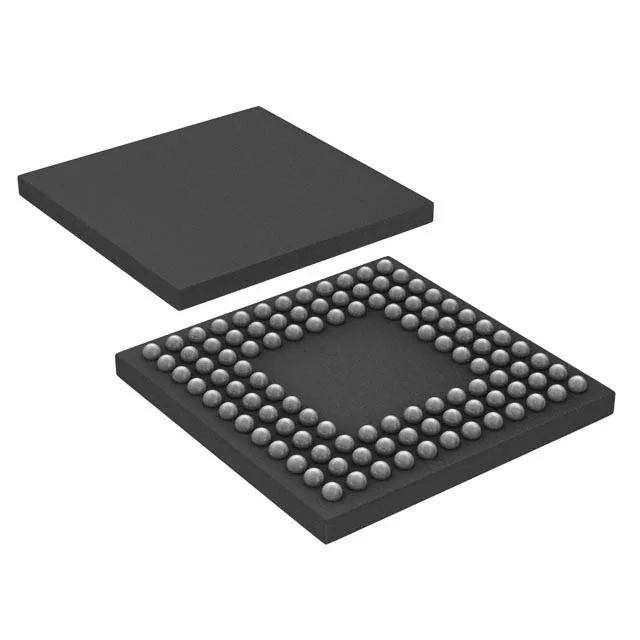
The device is supplied in a 108-ball LFBGA package (10x10 mm body) — a fine-pitch BGA that requires a multi-layer PCB for fan-out of the inner ball rows. The 0.50 mm ball pitch demands careful via-in-pad or microvia design to route all 67 I/O plus power and ground balls without excessive layer count.