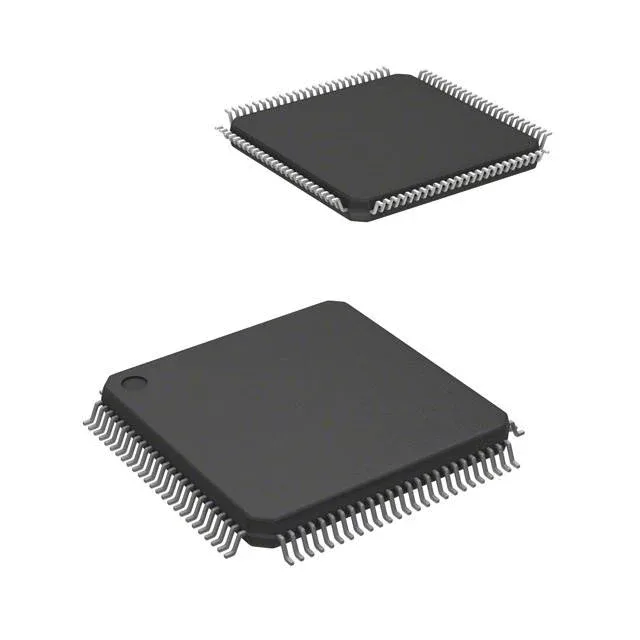
At 80 MHz the Cortex-M3 delivers roughly 1.25 DMIPS/MHz, so the LM3S5D51 can sustain about 100 MIPS of integer throughput. That is enough to run a control loop with a 100 µs period, service a USB bulk transfer, and keep a CAN stack alive without resorting to the DMA engine — though the part does include a DMA controller for offloading memory-to-peripheral moves. The internal oscillator is available, but for CAN or USB operation an external crystal is recommended to keep the bit timing within tolerance across temperature.
Memory map and firmware staging
The 512 KB Flash is organised as 512K x 8 and is used for both code and constant data. With a typical RTOS kernel taking 20–40 KB and a USB stack another 30–50 KB, there is room left for application logic and a small file system. The 96 KB SRAM is split across multiple blocks in the memory map; the exact partitioning matters if you are allocating large DMA buffers or a USB packet buffer — check the memory map in the datasheet to avoid fragmentation. The Flash endurance is rated for 100k write/erase cycles per sector, which is fine for field-upgradeable firmware if you use a wear-leveling scheme in the bootloader.
Connectivity and I/O count
With 67 GPIOs brought out on the 100-pin LQFP, the LM3S5D51 can support a parallel LCD interface, a keypad matrix, and several serial ports simultaneously. The connectivity list includes USB OTG (with built-in PHY), two CAN 2.0B controllers, IrDA, LIN, and a Quadrature Encoder Interface (QEI) for motor position feedback. The 16-channel 12-bit ADC samples at up to 1 Msps — adequate for reading potentiometers, current-sense resistors, or thermistor inputs in a motor-drive or HMI application.
The supply range of 3.0 V to 3.6 V means a single 3.3 V rail powers the core and I/O — no separate 1.8 V core supply needed.
There is no official TI successor listed for this exact order code, and the Stellaris family has been superseded by the Tiva™ C Series and later TM4C devices. If you are evaluating a drop-in replacement, the closest functional match within the same footprint and peripheral set would be a TM4C123 or TM4C129 part from TI's current portfolio, but pin compatibility and software migration need to be verified against your specific board revision.